

The first part of our adventure took us to the dry, brushy landscape of Samburu National Park. I’ve been here maybe a half dozen times and it’s always a wonderful place for many subjects, but especially elephants. This year has been no exception, but the highlight of our three days in Samburu was a cheetah chase I had the opportunity to document.
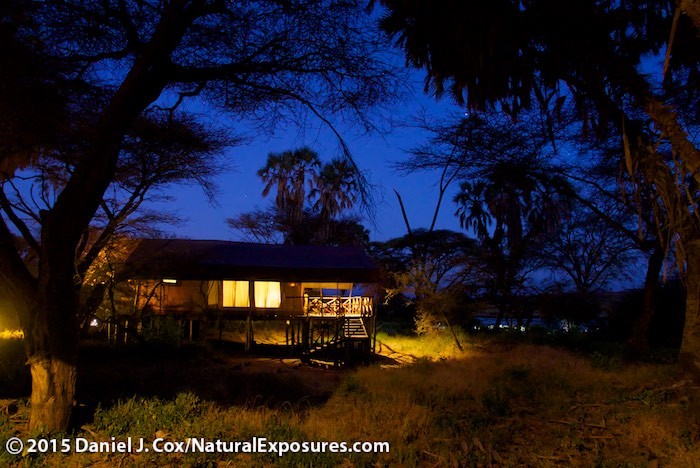
 Dusk falls over our tent at Elephant Bedroom camp in Samburu National Reserve, Kenya. Lumix LX100 ISO800
It all took place yesterday at the start of our afternoon game drive. We left Elephant Bedroom at 4:00pm and made our way out into the park. It was hot, nearly 100F. Our driver Felix took us to an area we knew a mother cheetah and her two older cubs had been seen. Cheetahs in Samburu are not real common.
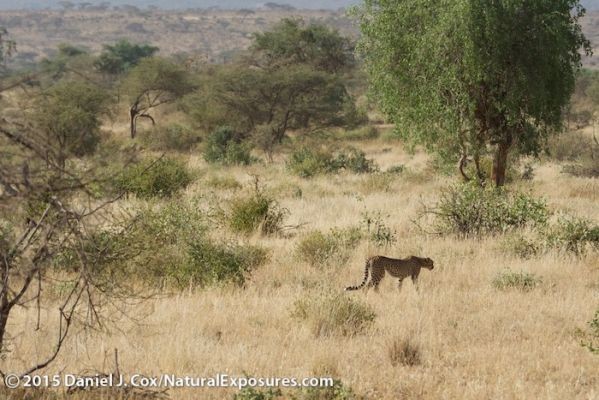
 A mother cheetah makes her way through the hot, bushy landscape of Samburu National Reserve. Kenya. Lumix GH4 with Olympus 40-150mm F/2.8. ISO250
Though we saw a pair two years ago, this area is not quality cheetah habitat. Ideally they typically prefer wide open plains and little or no brush where they can reach the maximum 70mph+ they need to catch the numerous fleet footed antelope that call Samburu home. Their favorite prey, the Thomson’s gazelle, is nowhere to be found on this arid, bushy landscape. Here, the cheetah rely on the young of Grant’s gazelle and impala as well as adult dik diks, African hares, and other small game.
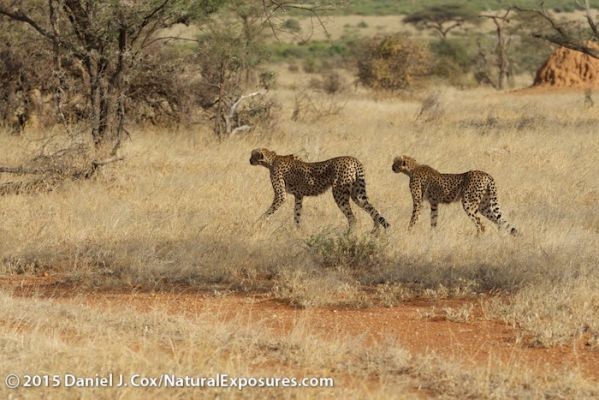
Mother cheetah and one of her two older cubs begin to hunt a herd of Grant’s gazelle. Lumix GH4 with Olympus 40-150mm F/2.8. 250ISO
We arrived on the scene to see the mother and her two older cubs, babies that look almost full grown, stalking a heard of Grant’s gazelle. The mother and one cub walked slowly in a hunched crouch, taking one stuttered step and then the next as if walking on a cushion of air. Their eyes were locked on the grazing gazelles when suddenly the cub’s head shot a glance quickly to the right and broke off the stalk to investigate. Slinking through the short grasses, she went 30 yards or so and pounced. There beneath its paws springing to life was baby Grant’s gazelle. Instantly the chase was on.
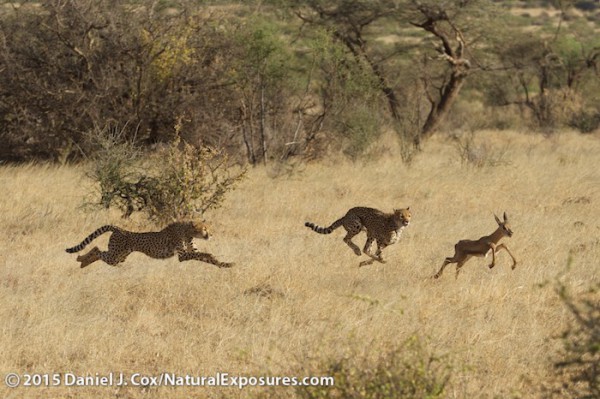
This is the frame I was able to get that summed up the entire scene although there are many more images from start to finish. For a gallery of the entire chase click on this link. Lumix GH4 with Olympus 40-150mm F/2.8. 250ISO
Young cheetahs are not born great killers and though the pounce looked decisive, the baby gazelle at least had a few more moments to live. It literally ran for the living with all three cheetahs in a life or death pursuit. All mother cheetahs will let their cubs dominate the chase, allowing them learn the basics of feast or famine. This mother was no different as the two cubs put on a half-hearted attempt to catch and kill. They finally brought the baby gazelle to the ground and the rest I won’t even describe since any life being distinguished is never enjoyable to report.
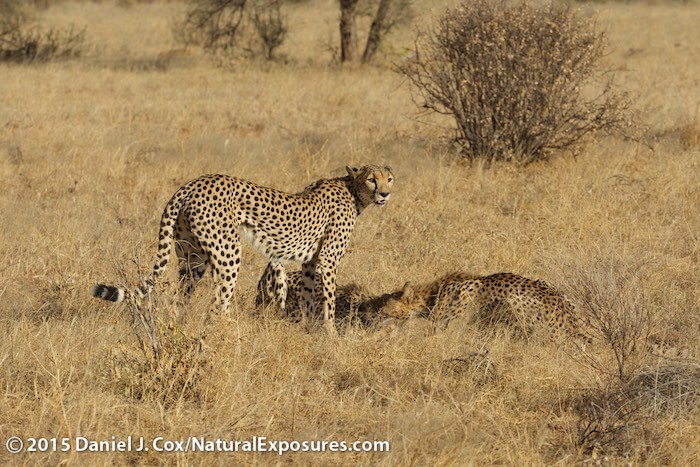
 The mother cheetah stands over her two cubs as they begin to feed. Samburu Nationa Reserve, Kenya, Lumix GH4 with Olympus 40-150mm F/2.8
The circle of life was consummated that day with three very slender cheetahs, obviously in need of a meal, connecting the ends and living for another day. From a photographer’s perspective it was not only a chance to document the reality of the African bush, but it was a phenomenal opportunity to test my new camera gear. Ever since I began shooting the Panasonic Lumix MFT system I’ve used the cheetah chase as the defacto example of what the new mirrorless cameras CANNOT do. Wow, was I proven wrong.
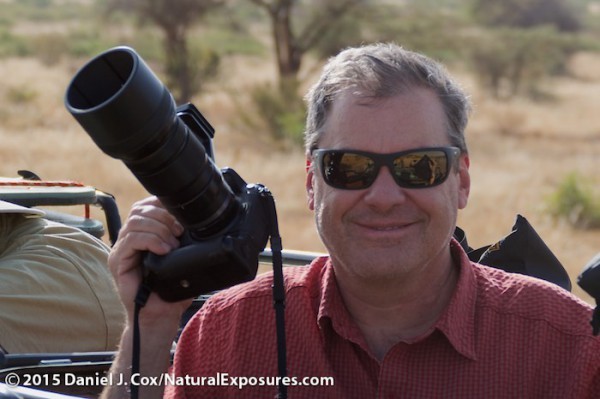
Daniel Cox holding the Lumix GH4 with Olympus 40-150mm F/2.8 lens. Photo by Tanya Cox. Lumix FZ1000 125ISO
So here are the photography details. First, I was shooting the Lumix GH4 with the new Olympus 40-150mm F/2.8 attached. For those not familiar with MFT cameras, you need to multiply the lens by 2. So in this case I was shooting an 80-300mm F/2.8. This is my first trip with the new Olympus lens and it is performing better than I could have even imagined. Not only is it as sharp as any lens I’ve ever shot, it is rocket fast when used with the Lumix GH4. The collection of photos I captured are better than any cheetah chase I’ve ever shot. There is always some luck involved with a cheetah hunting but thankfully the camera and lens handled this difficult task with ease.
The camera was set to AF-S which gave me a blistering 12 FPS. I normally would have had the camera set to AF-C but I missed switching it over before the chase ensued. I always have my GH4’s set to Back Button AF and as the cats began the chase I focused on them as they ran from one point to the next. I have to admit, I was concerned about critical focus when I realized I had set the camera to AF-S, but I wasn’t disappointed when I brought the images up on my computer. Almost every image was razor sharp. Was there some benefit to the added depth of field of the MFT sensor? I actually think there was. More depth of field has always been one of the whining points many photographers obsess over when I peruse the forums regarding MFT cameras. I’ve always been of the opinion that I’ve never had a problem with getting pictures OUT OF FOCUS. My problem has always been getting pictures IN FOCUS. MFT cameras give you more depth of field and that may have worked in my favor in this once-in-a-life-time situation. Either way I came away with some amazing images that blew my defacto example of what MFT cameras can’t do, right out of the water.
Regarding technical details, I was shooting ISO 250 which gave me a very fast 1/1600th of a second at F/4.5. One of downsides to the Olympus lens on a Lumix camera is the lack of Image Stabilization. Olympus builds IS into the body and Lumix builds their IS in to the lenses. That being the case I often shoot this lens at higher ISO’s which gives me faster shutter speeds. This day there was plenty of light so I was able to stick with a very modest 250ISO. I think the images speak for themselves. It was an amazing shoot and a great day for the cheetah family. Unfortunately, not such a great day for the gazelle.
Previous Kenya episodes of The Lumix Diaries.
The Lumix Diaries Heads to Kenya
The Lumix Diaries Kenya 1/10/2015