

Today, January 5, at 10:00am Vegas time, Panasonic finally announced the ability to order the new Leica Lumix 100-400mm zoom. It’s a professional quality lens I’ve been dreaming about ever since I started getting serious about the Lumix line of cameras nearly six years ago. Today is the day we can go down to our local camera shops, or order online if you don’t have a Lumix dealer near you, to get on the list for first availability. And I do suggest you do it it quickly since this lens is going to be a very hot commodity at a price of $1799.00. I’m guessing Panasonic will sell the first batch out in short order.
Here is a list of preferred Lumix dealers you might want to try if you don’t have a Lumix dealer near you.
Bozeman Camera (800-944-2139)– I spoke to Marshal, the owner, and he told me they have ten 100-400’s pre-ordered and he has five sold already. That means he will have five ready to go. I often find smaller dealers have more product than the larger dealers since everybody knows about B&H Photo but few know about Bozeman Camera. Give these guys a try. You won’t regret it. You do have to call however since they do not take online orders.
Panasonic Direct at shoppanasonic.com. I’ve had very good luck with this online order option. Typically product arrives in 2-3 days and all has gone very well. However, I prefer ordering from Bozeman Camera when I can.
B&H Photo and Video. Everybody knows B&H. They have a stellar reputation but they are my last resort. We need to support our local camera dealers if at all possible but there are few local camera stores anymore. We’re lucky in Bozeman to have both F11 Photo and Bozeman Camera. Support your local dealer whenever possible.
Panasonic Chief Engineer Yabuki san Comes to New Mexico
Ok, so that’s the exciting news that was recently reported. But equally exciting is the fact I’ve been shooting two of these Leica-glassed bad boys for almost a month now, producing promotional materials that will soon be appearing around the world. Quite an honor I have to say and one I appreciate greatly. Shooting this ad campaign was a dream assignment. Panasonic gave me free rein to capture whatever I wanted, as long as it was wild in nature—yes, pun intended 🙂 Go figure. That was certainly fine with me and to get myself in the right place I booked a ticket to New Mexico to visit one of my favorite national wildlife refuges, Bosque del Apache. Ok…so those who know me know it wasn’t me who booked the tickets.
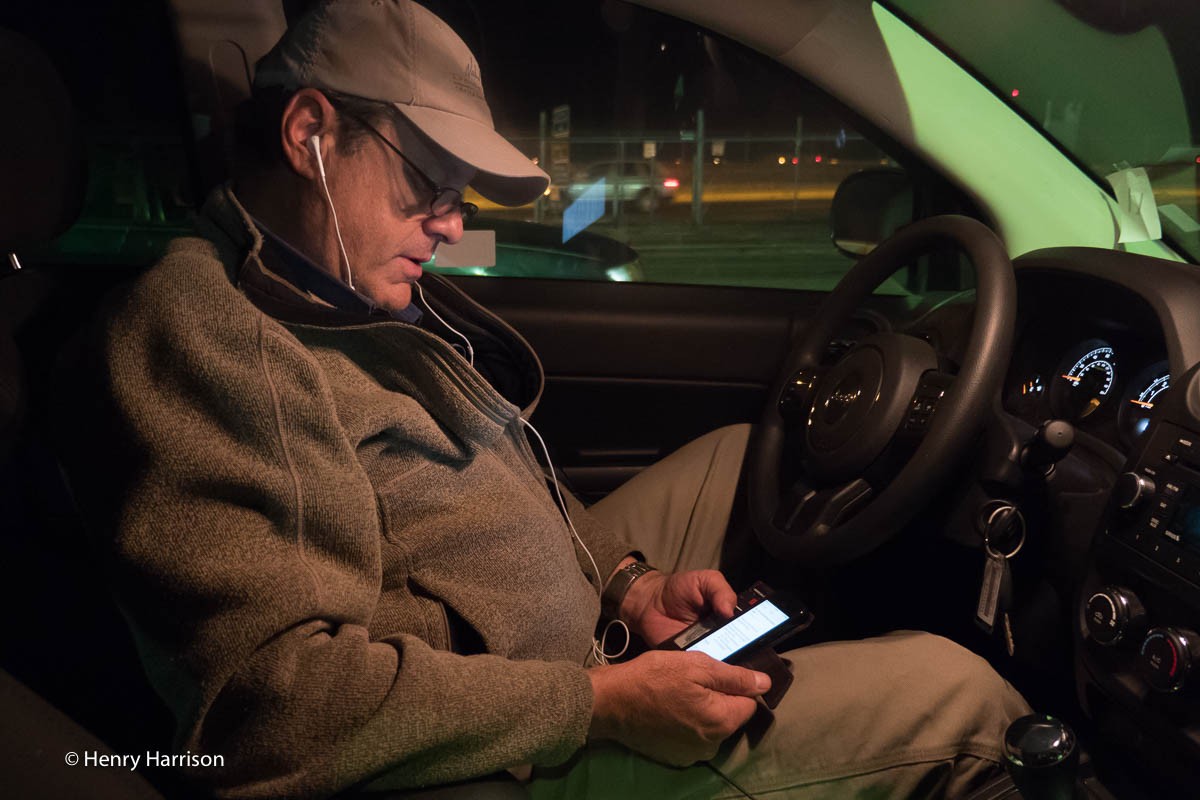
 Dan waiting for a text message from Panasonic engineer coming to New Mexico to drop off lenses. Lumix GX8 with 12-35mm, ISO3200
Yes, Ms. Tanya the Logistics Queen got the whole thing set up and I just had to be on time to catch the flight to Albuquerque. And though that all sounds pretty easy it was actually considerably more complicated. Why? Well it seems the day I got the assignment Panasonic was still a good two months from delivering something I could actually use. There have been many samples/prototypes floating around the tradeshow circuit but none of them were working samples. I was going to be getting the first two working 100-400mm Leica Vario-Elmar lenses in existence.
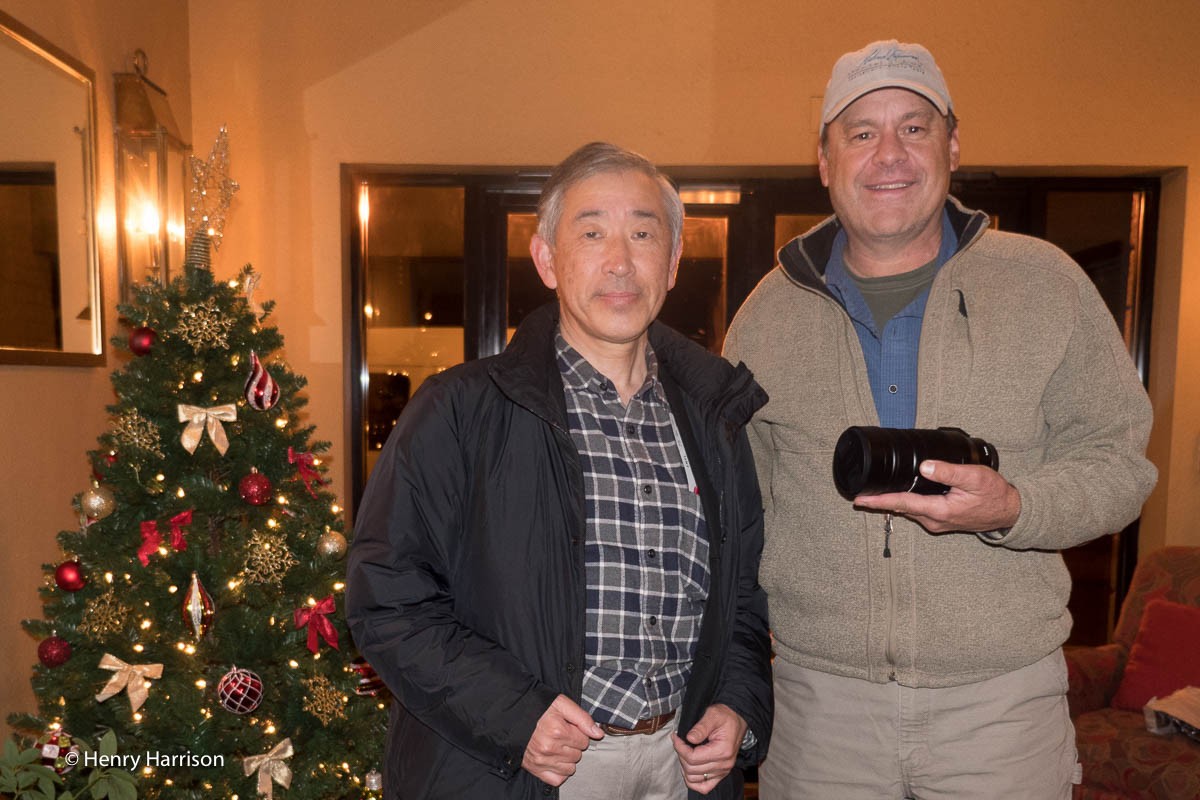
 Panasonic Chief engineer Takanori Yabuki hands Daniel Cox the new 100-400mm zoom lens for a shoot in Bosque del Apache NWR, New Mexico.
The first plan was for two Panasonic engineers to fly to Bozeman to hand deliver the two lenses. That plan got scratched due to production scheduling. The next plan was about a week later than the original and with a goal of just getting the lenses to me ASAP via FedEx overnight. By this time I had booked my tickets to Albuquerque when round three materialized which included another production issue. Not unusual when you consider these two lenses were built by hand and the first two to roll off the production table.
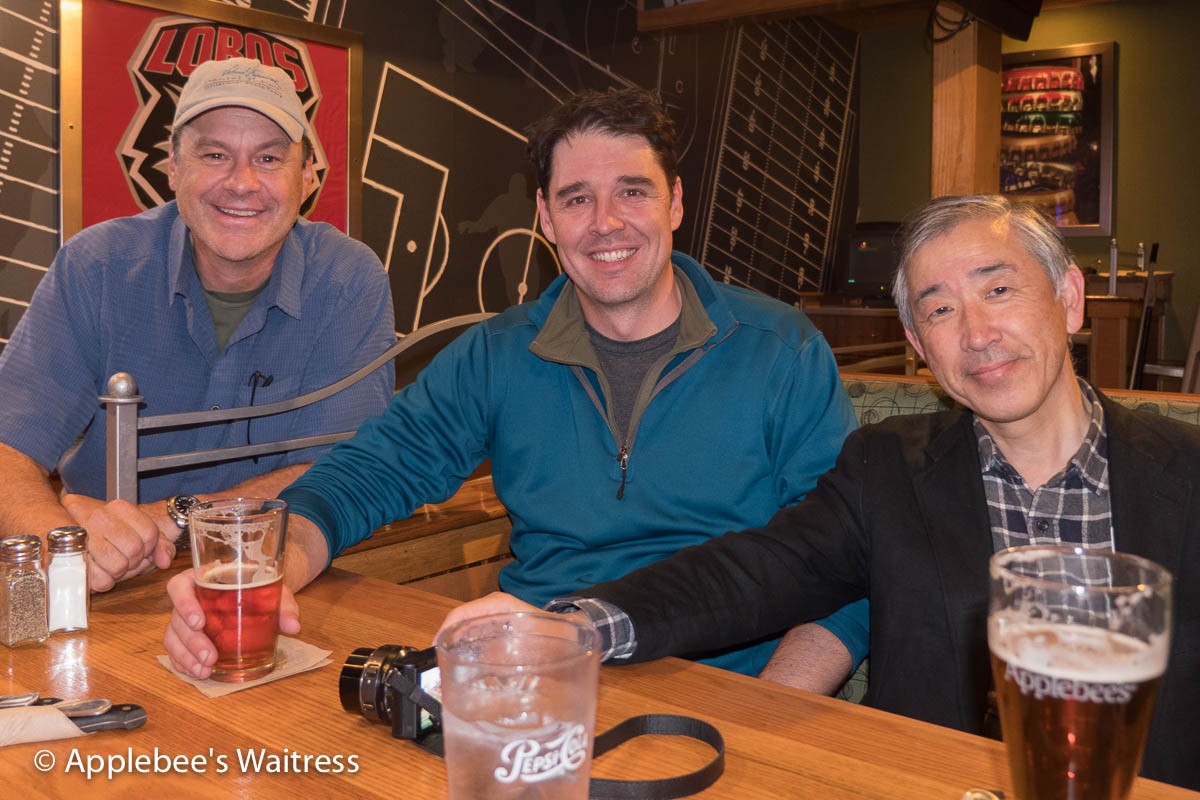
 Dan, Henry Harrison, and Panasonic Chief Engineer Takanori Yabuki at Applebee’s in Albuquerque, New Mexico.
So the new and final strategy? Send one Chief Engineer directly to Albuquerque, meet me there, hand deliver lenses after arriving at 8:00pm, take engineer to Applebee’s and feed engineer big American steak and one very tall beer, put engineer to bed in Ramada Hotel whereupon the next morning at 8:00am he boards the next flight back to Osaka. Wow… poor Yabuki san! So that’s how the week of December 8th. began.
Henry Harrison Goes Behind the Scenes
When we got the go ahead for this assignment I immediately thought it might be interesting to do a behind the scenes video. I spoke to the folks at Panasonic and they agreed. To get it rolling I contacted friend and fellow storyteller Henry Harrison who I met through my work with Polar Bears International. Tanya booked Henry a ticket and we were on our way.
December 8, 2015
Henry and I get to Albuquerque and make our way south down highway 25 to the little town of Socorro, New Mexico. The Holiday Inn was our base for the next week which was only 15-20 minutes from the edges of Bosque del Apache NWR. Just outside the refuge is a tiny, sleepy town known as San Antonio. Not THE San Antonio in Texas, but the San Antonio of New Mexico variety.
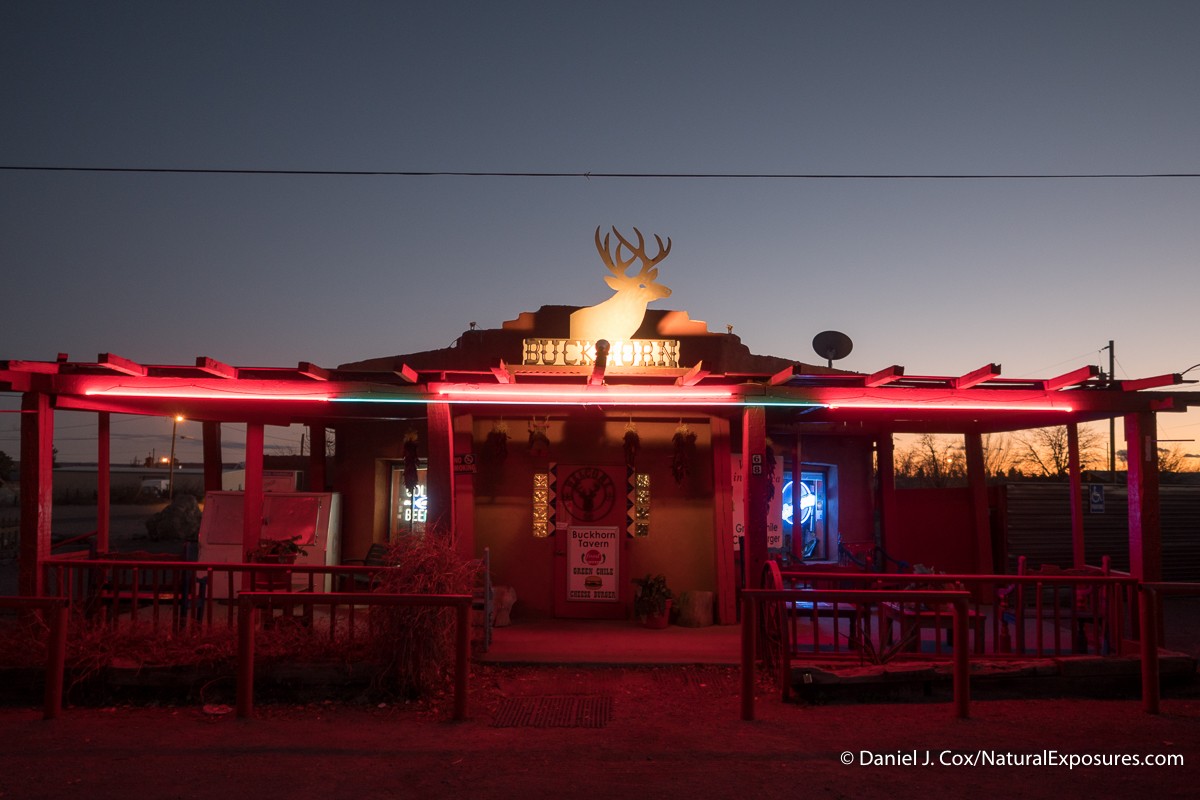
 The Buckhorn tavern, San Antonio, New Mexico. Lumix GX8 with Olympus 12mm F/2.0 lens, ISO 200
This San Antonio has one street with a gas station, an auto repair garage, and a very photogenic bar called the Buckhorn. All of this just a few miles before the boundaries of Bosque del Apache which is an important part of the of the wildlife refuge system throughout the United States.
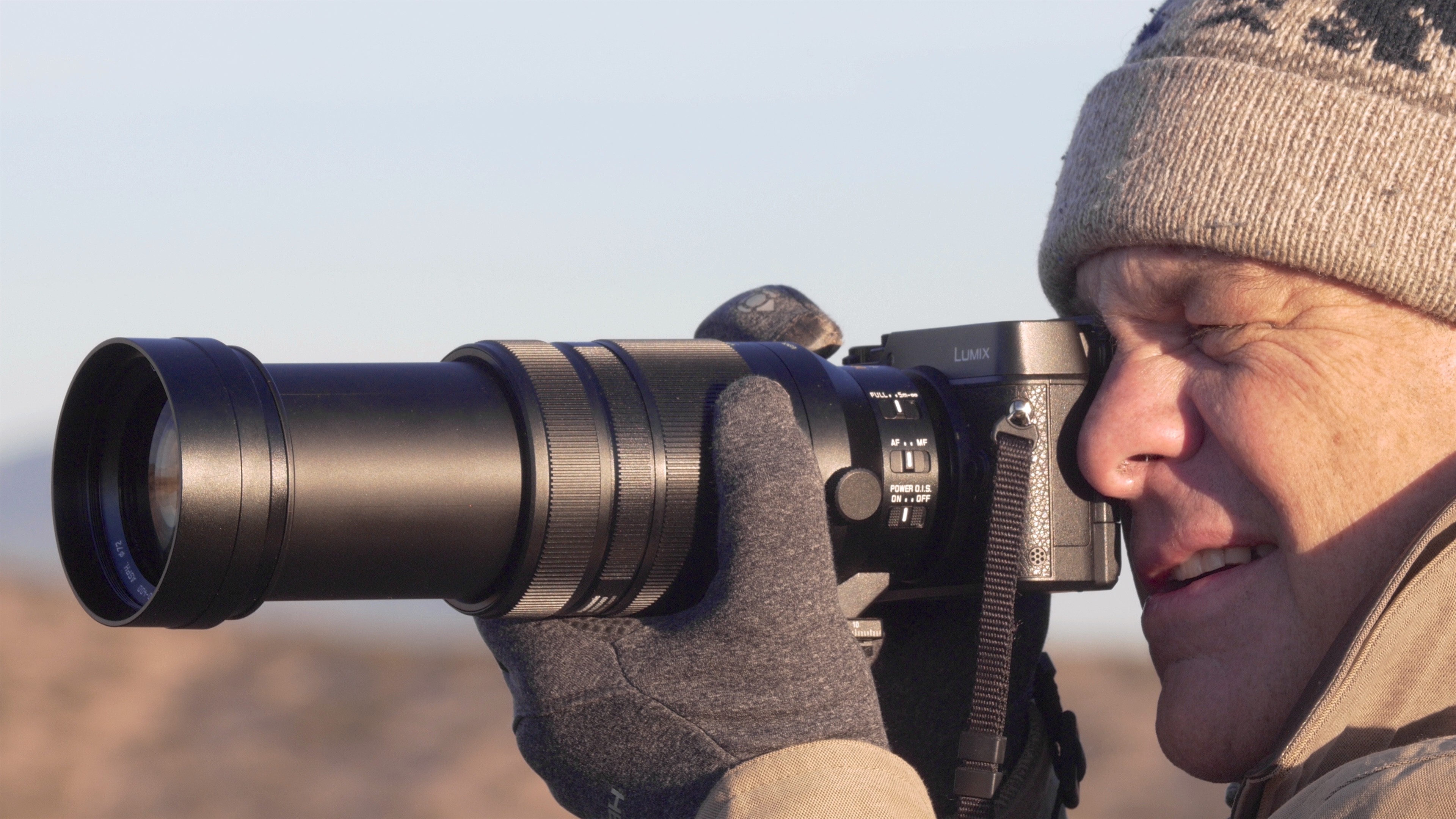
 Me shooting the 100-400mm hand-held zoomed all the way out to 400mm.
The official Bosque del Apache website describes that it was, “Established in 1939 to provide a critical stopover for migrating waterfowl, the refuge is well known for the thousands of sandhill cranes, geese and other waterfowl that winter here each year.
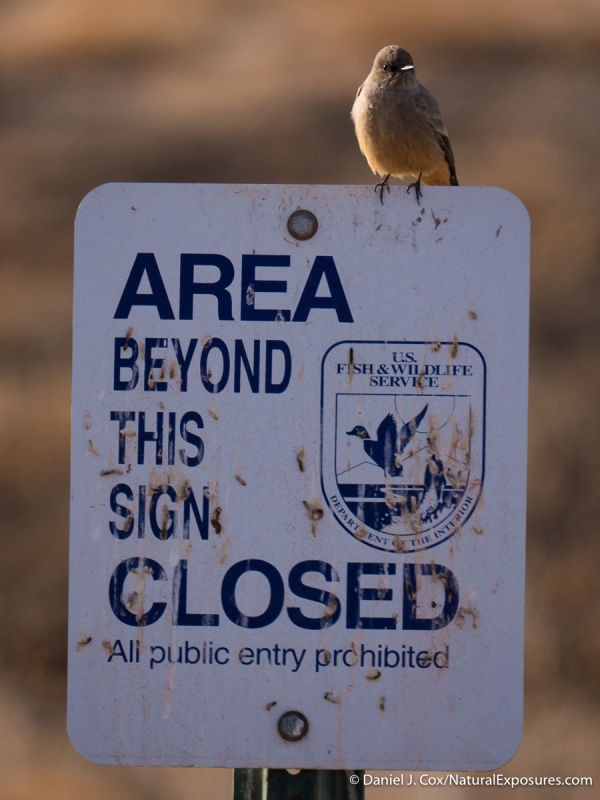
 A Say’s Phoebe sits atop a NWR sign, Bosque del Apache NWR, New Mexico. Lumix GX8 with 100-400mm Leica Vario-Elmar zoom
Situated between the Chupadera Mountains to the west and the San Pascual Mountains to the east, the 57,331-acre refuge harbors a wild stretch of the Rio Grande, a ribbon of cottonwood and willow trees visible on the landscape from distant mesas.”
In other words, it’s a wildlife oasis in the middle of a very dry and arid region that sits nearly a mile high and surrounded by a landscape full of mesquite trees and some cottonwoods.
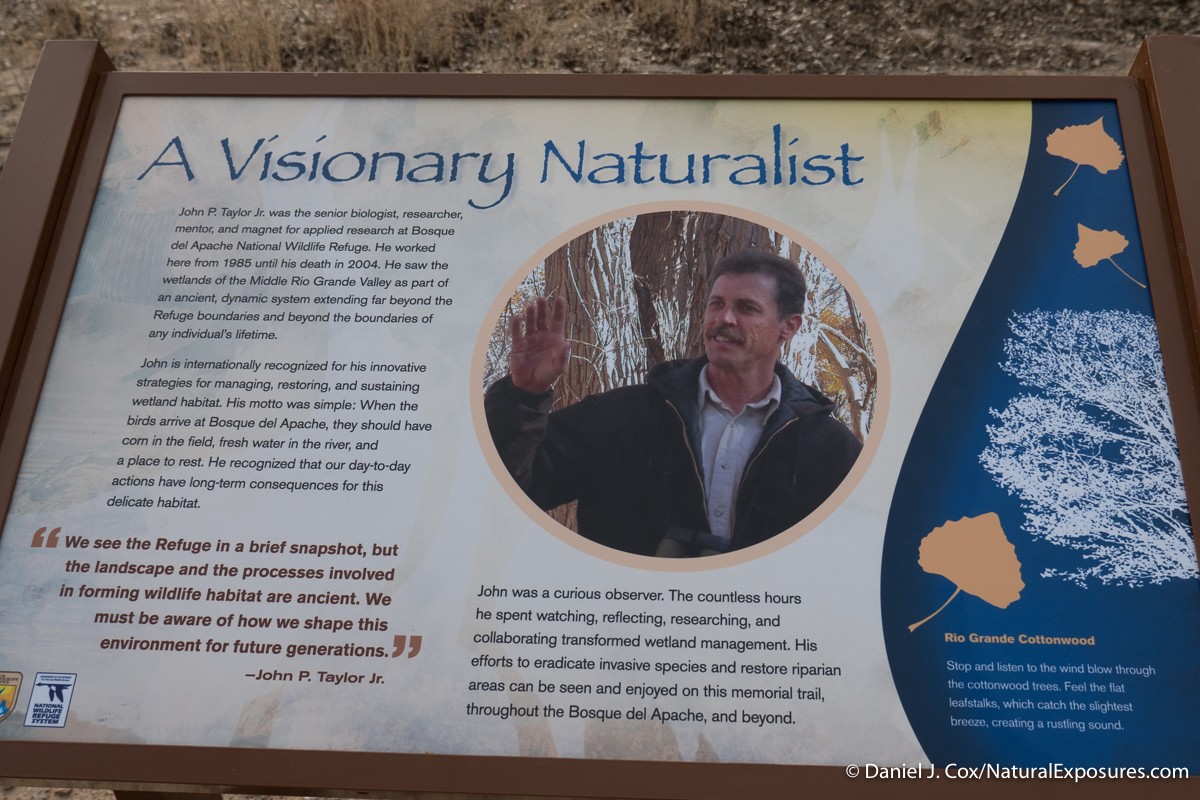
 A sign explains the dedicated work of John P. Taylor who spent his time at the refuge as a biologist and outspoken supporter of this wonderful ecosystem. John apparently died at an early age and is memorialized throughout the refuge for his dedicated work. This is a link to John’s memorial and history. Must have been an amazing guy.
There are not many places in the states that you can be pretty much be guaranteed there will be enough subjects for a wildlife assignment, but Bosque didn’t let us down.
Henry and I arrived late the morning of the 8th. picked up our rental car and drove for the refugee. We spent that afternoon and evening photographing and getting to know the area. I had visited Basque in the 90’s but it seemed completely different.
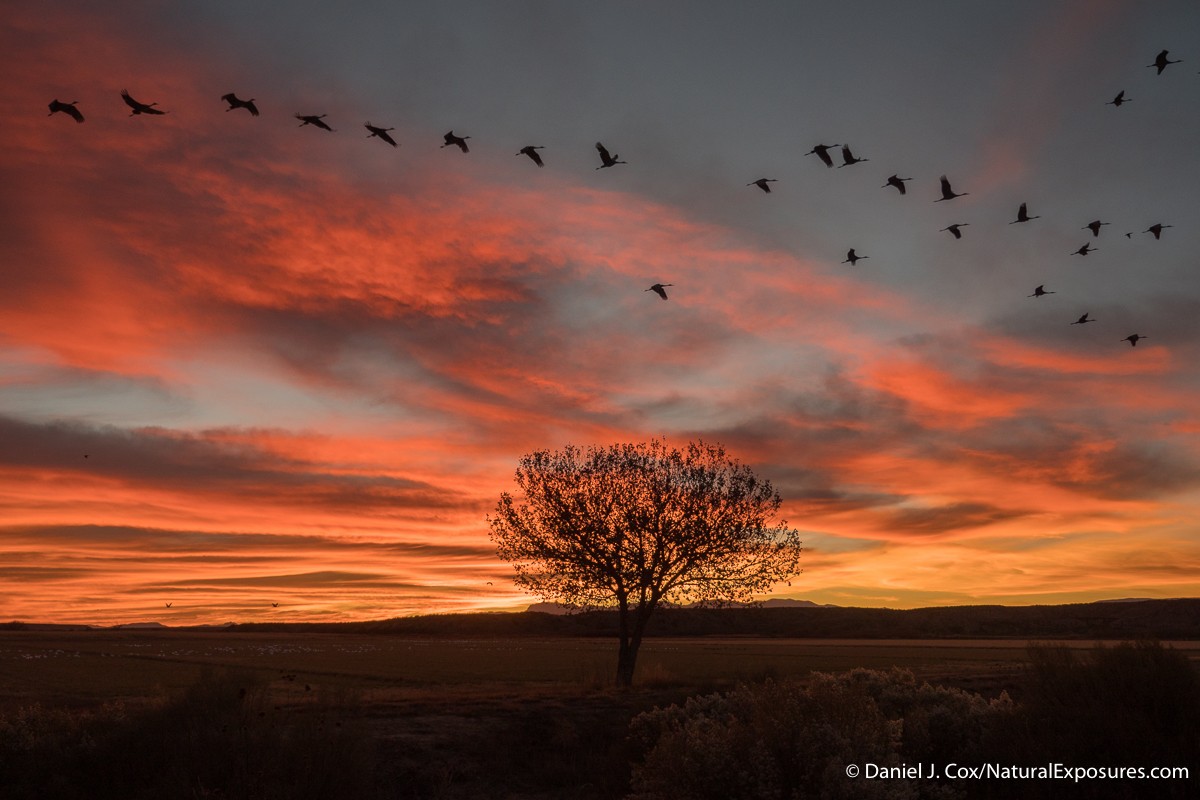
 Sandhill cranes in flight against a beautiful sunset at Bosque del Apache NWR, New Mexico. Lumix GX8 with 12-35mm F/2.8, ISO200
There are lots of lakes and small ponds, corn fields, and tilled farm land. Much of it’s flooded, all of it for the benefit of the migrating geese, cranes, and a multitude of smaller waterfowl. We explored the north and south loop but the hot spots were the two small ponds at the very entrance to the refuge. Here we found not only geese and cranes but several dozen photographers. Lots of big lenses and even bigger tripods.
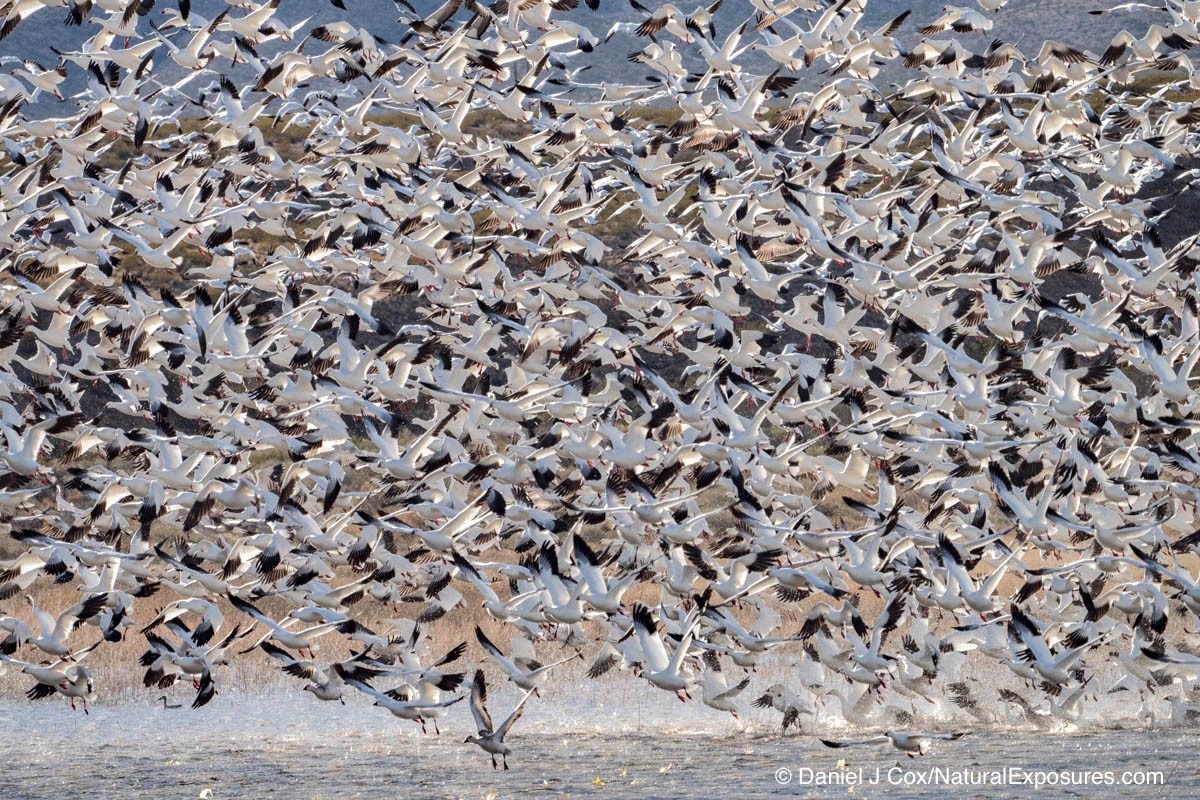
 Snow geese lift off from a small pond at Bosque del Apache NWR, New Mexico. Lumix GX8 with 100-400mm zoom, ISO 320
Only one or two people over the course of a week made contact with me. Nobody had any idea nor did anyone care that I was shooting something new. Nobody had any clue, I was just a guy on the sidelines shooting some small little camera, a comparatively small lens, a photographer who obviously wasn’t really serious. How could he be? He’s got such small camera equipment?
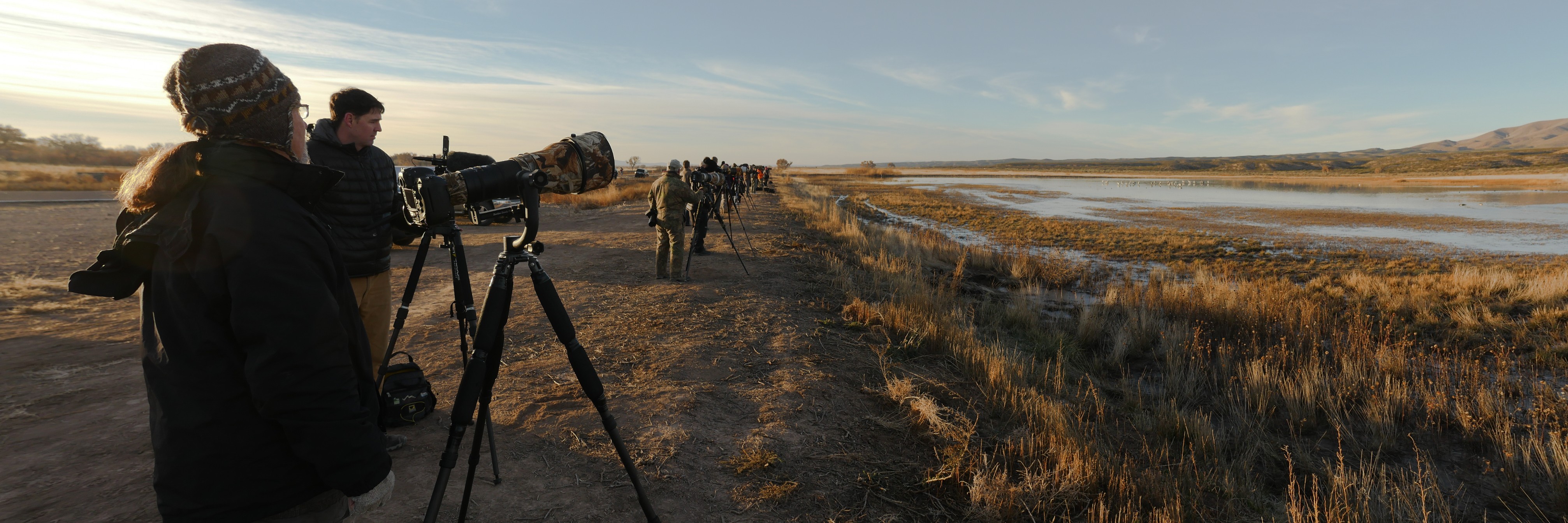
 Henry Harrison on the job with a group of other photographers at Bosque del Apache NWR, New Mexico. Lumix GX8 with 12-35mm F/2.8 in Panoramic Mode, image stitched in camera, ISO 100
That’s exactly what I love about these new Lumix cameras and lenses. They draw almost no attention which is extremely helpful when shooting on the streets of Europe during some of our Cultural Photographic Tours. People are not intimidated by such small photography tools. They don’t see you as a professional, they all think you’re a tourist and subjects drop their guard. This is a very underrated benefit of the Micro Four Thirds cameras that Panasonic is making. It also worked to my advantage during my shoot at Bosque since I was not allowed to discuss anything about this lens and thankfully almost nobody approached me.
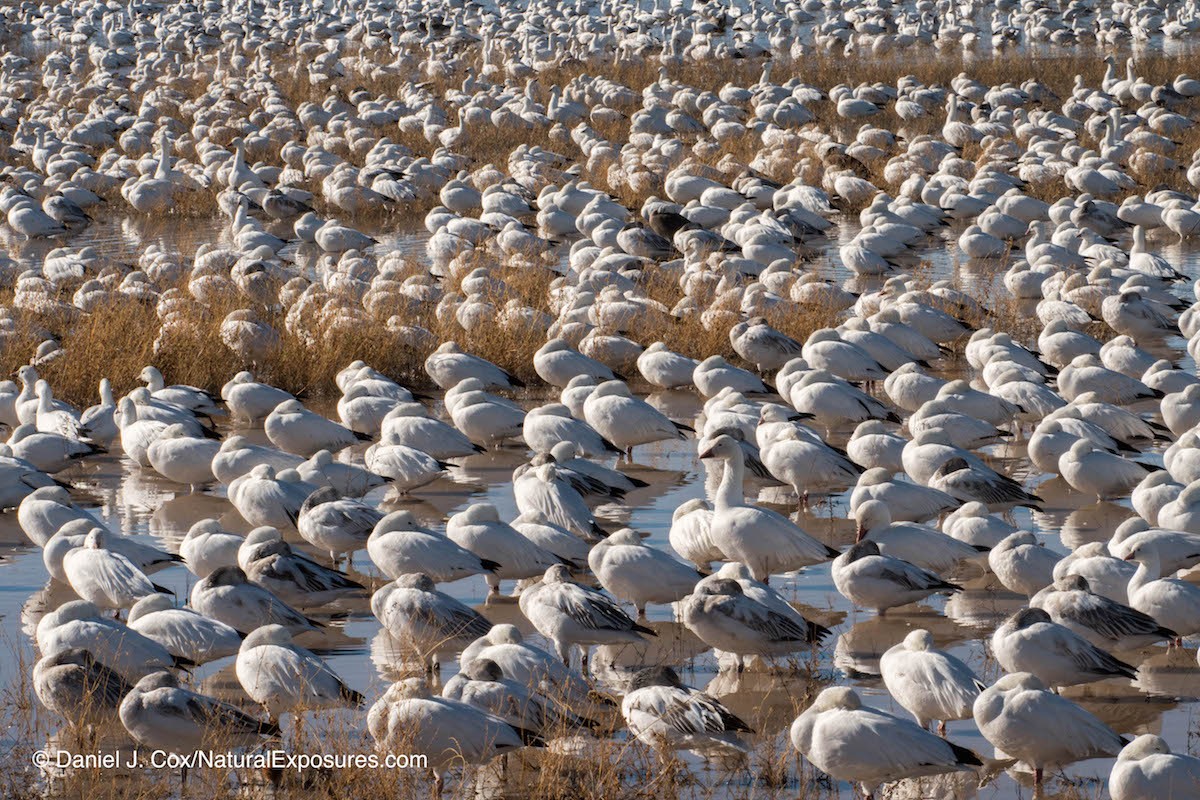
 Snow geese resting mid-morning, Bosque del Apache NWR, New Mexico. Lumix GX8 with 100-400mm lens, ISO 200
Henry spent the next three days shooting with me, covering everything from our 5:30am sunrises to the 6:00pm sunsets and everything in between.
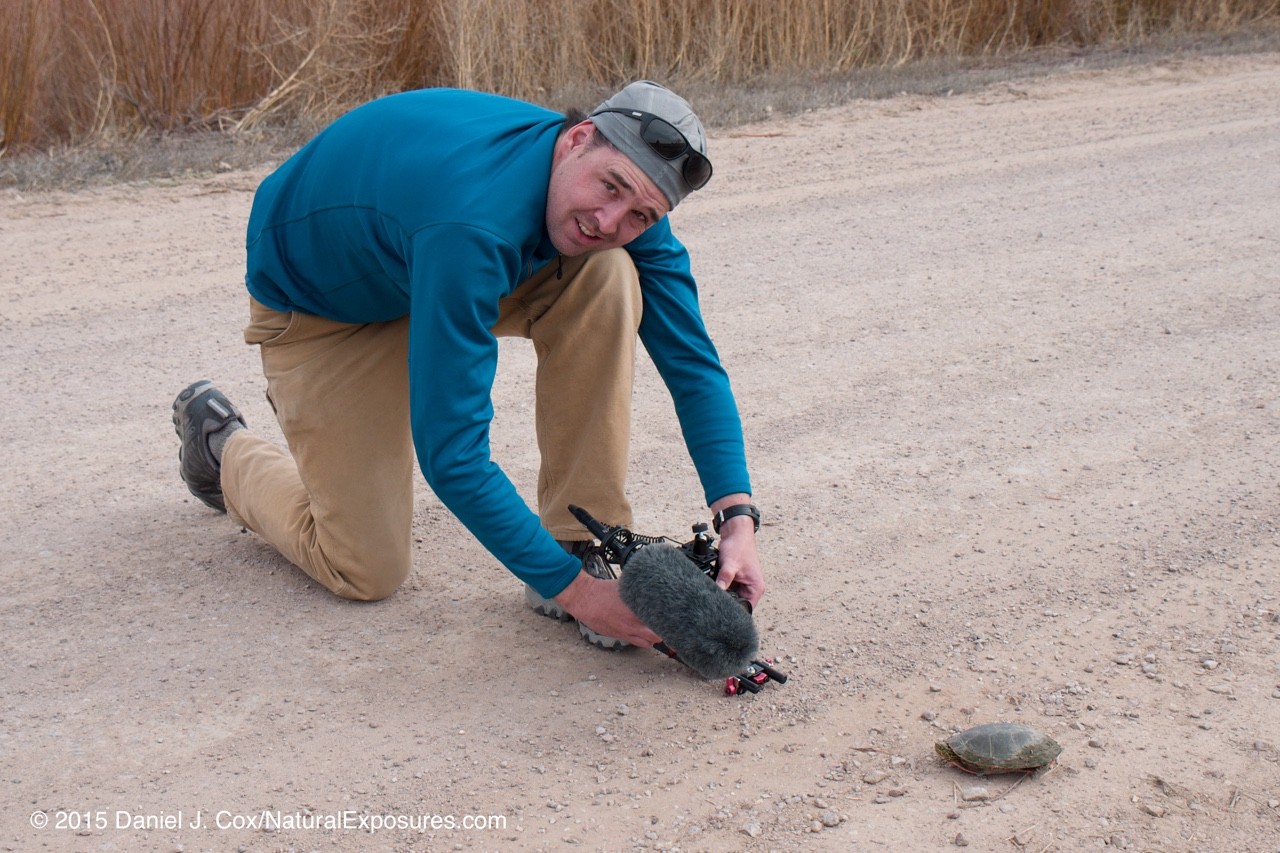
 Henry Harrison filming a painted turtle at the Bosque del Apache National Wildlife Refuge, New Mexico. Lumix GX8 with 12-35mm F/2.8
Subjects included a painted turtle, songbirds, Canada geese, the obvious snow geese and sandhill cranes as well as mule deer and the collared peccary. There were many different species of ducks including the northern shoveler, pintails, mallards, widgeons, and coots. Subjects galore, especially birds which is great subject matter for a lens that reaches out to 800mm.
This Was Not a Test Report
The week I spent with these two new lenses was a great time to get an idea if Panasonic is on track with this greatly anticipated and soon-to-be highly coveted new lens. I chose not to write a specific report on the details of this new optic since the two I was shooting were basically prototypes, literally built by hand and somewhat different than what we will soon see. I will say that the auto focus was exceptionally fast and accurate and the glass is extremely sharp. It focuses as close as 1.3 meters or 4.2 feet and I shot the image of a goose feather below that was about three inches in length to give you an example.
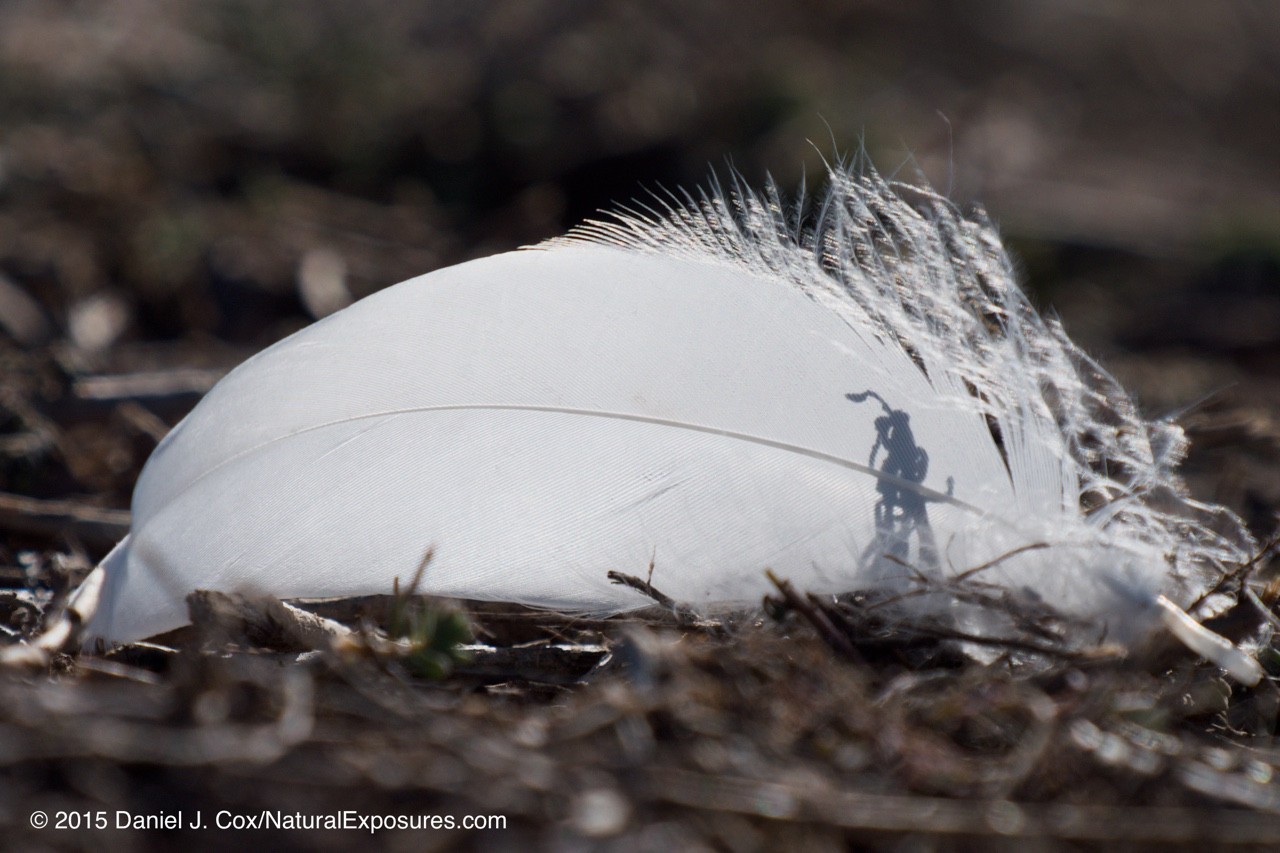
 Snow goose feather lies in the grass. Bosque del Apache NWR, New Mexico. Photographed at 400mm at closest focus setting of 4.2 feet with GX8 and 100-400mm lens
The 100-400mm is not light but it’s not heavy. It’s a reasonable weight for the quality build and number of elements a lens of this range requires. I’ll be writing more about the details once I get a final version to shoot and test. Until then, please enjoy the gallery of images below that were all shot with the new Leica Lumix 100-400mm zoom. This is the lens I’ve been hoping for and it’s an amazing time to be enjoying photography. The days of 12-pound telephotos is nearing an end!
Specifications of the New Lens
|
LEICA DG VARIO-ELMAR 100-400mm / F4.0-6.3 ASPH. / POWER O.I.S. |
|
|
Lens Construction |
20 elements in 13 groups (1 aspherical ED lens, 1 UED lens, 2 ED lenses) |
|
Nano Surface Coating |
– |
|
Mount |
Micro Four Thirds mount |
|
Optical Image Stabilizer |
Yes (POWER O.I.S.) |
|
Focal Length |
f=100-400mm (35mm camera equivalent 200-800mm) |
|
Aperture Type |
9 diaphragm blades / Circular aperture diaphragm |
|
Maximum Aperture |
F4.0(Wide) – F6.3(Tele) |
|
Minimum Aperture |
F22 |
|
Closest Focusing Distance |
FULL:1.3m/4.27ft, LIMIT:5.0m/16.4ft |
|
Maximum Magnification |
Approx. 0.25x / 0.5x (35mm camera equivalent) |
|
Diagonal Angle of View |
12°(Wide) to 3.1°(TELE) |
|
Filter Size |
φ72mm / 2.8in |
|
Max. Diameter |
φ83mm / 3.3in |
|
Overall Length |
Approx. 171.5mm / 6.75in (from the tip of the lens to the base side of the lens mount) |
|
Weight |
Approx. 985g / 34.74oz (excluding lens cap, lens rear cap, lens hood and external tripod mount) |
|
Standard Accessories |
Lens cap, Lens rear cap, Lens storage bag, External tripod mount, Lens hood |
Below is a photo gallery slide show of the ad campaign selects I shot during the assignment. All were shot with the Lumix GX8 and the new 100-400mm lens.
You can also see the same images in a more relaxing manner by clicking on this link Lumix 100-400mm Ad Campaign Selects. You may have to signup for a PhotoShelter account for this presentation.