

Rainy days and time away from a busy studio setting can be very productive. Especially if you’re as far north as Churchill, Manitoba. I’m visiting Churchill documenting summer in the arctic for the Arctic Documentary Project. I’ve been here for a few days staying at the PBI house. My first two evenings were beautiful though very hot for this part of the world. Unusually warm temperatures but the same old beautiful low arctic light for gorgeous landscapes. Here’s an image from last night.

 Thunderheads over Hudson Bay, not far from the PBI house in Churchill, Manitoba.
Today’s more normal weather has returned with heavy overcast and a lot of rain. I’m passing time doing some tests with a couple of new pieces of equipment – the recently released Nikon D800 and a not so new, but seldom used, 24mm PC lens. I’ve been comparing the 24mm PC lens to my old workhorse the 24-70mm 2.8 zoom. I don’t always get to do these things when I’m at home since a busy studio environment keeps me hopping. Detailed tests seem to get put on the back burner.
I’ve mentioned it before to those I’ve traveled with that I feel Nikon’s 24-70mm 2.8 zoom is a spectacularly sharp lens. This lens along with the 14-24mm 2.8 were the first optics I purchased from Nikon with the new Nano Crystal Coating. Nano Crystal Coating was announced 4-5 years ago. I don’t recall exactly when but at the time there was minor fanfare with mostly just a link to a white paper that Nikon had released describing the benefits to their new technology in lens coatings. I thought, “yeah right, just another ploy for us to all go out and update to a lot of expensive Nikkor lenses. Can’t blame them. I thought, wouldn’t I love for people to have to re-buy everything I ever originally sold them.” I acknowledged the hype but went on my way not really interested.
A few months passed and I began to think about replacing my old 35-70mm zoom for the new wider range of the 24-70. I had virtually forgotten about the fact the new lens had the Nano coatings. Mainly I had decided to update for a wider optical range. At the same time I also decided to try the super wide 14-24mm since I’m a huge fan of the ‘wider the better’ philosophy. I shoot a lot of telephotos in my wildlife and nature work but my favorite lenses are my wide angles. Call me strange.
So today I created a challenge for the two lenses. In the PBI house is a section of tongue and groove pine paneling. The key to the test it to have a flat, even surface and the wall fit these requirements just fine. I set up my tripod about three feet out from the paneling and shot both lenses from their widest aperture to their smallest, all in one-stop increments. The results were very surprising.
The first thing I noticed on the 24-70 was the serious optical issues with straight lines, often referred to as distortion. It was substantial and disturbing. Compared to the fixed 24mm PC lens the 24-70mm seemed almost defective, but in reality it’s no worse than you can expect from any zoom lens pushing the limits of optics.. Take a look at the image below to see what I mean.
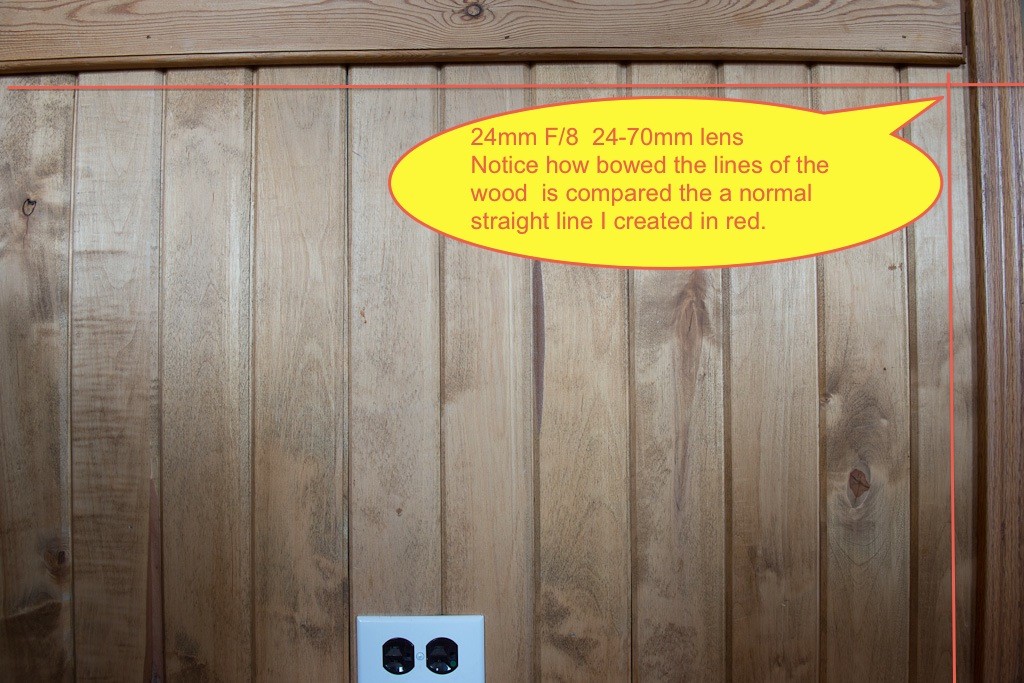
 24-70mm lens at 24mm. A lot of lens distortion.
Below is a sample of the same image above corrected within Lightroom’s Lens Correction module. The distortion issue is really a non-issue if you are using Adobe’s Lightroom 4 which has these Lens Correction tools. I’m a big fan of Apple’s Aperture but admittedly, not as much as before I tried this new tool in Lightroom 4. Wow, this is a powerful option I wished desperately Aperture had.
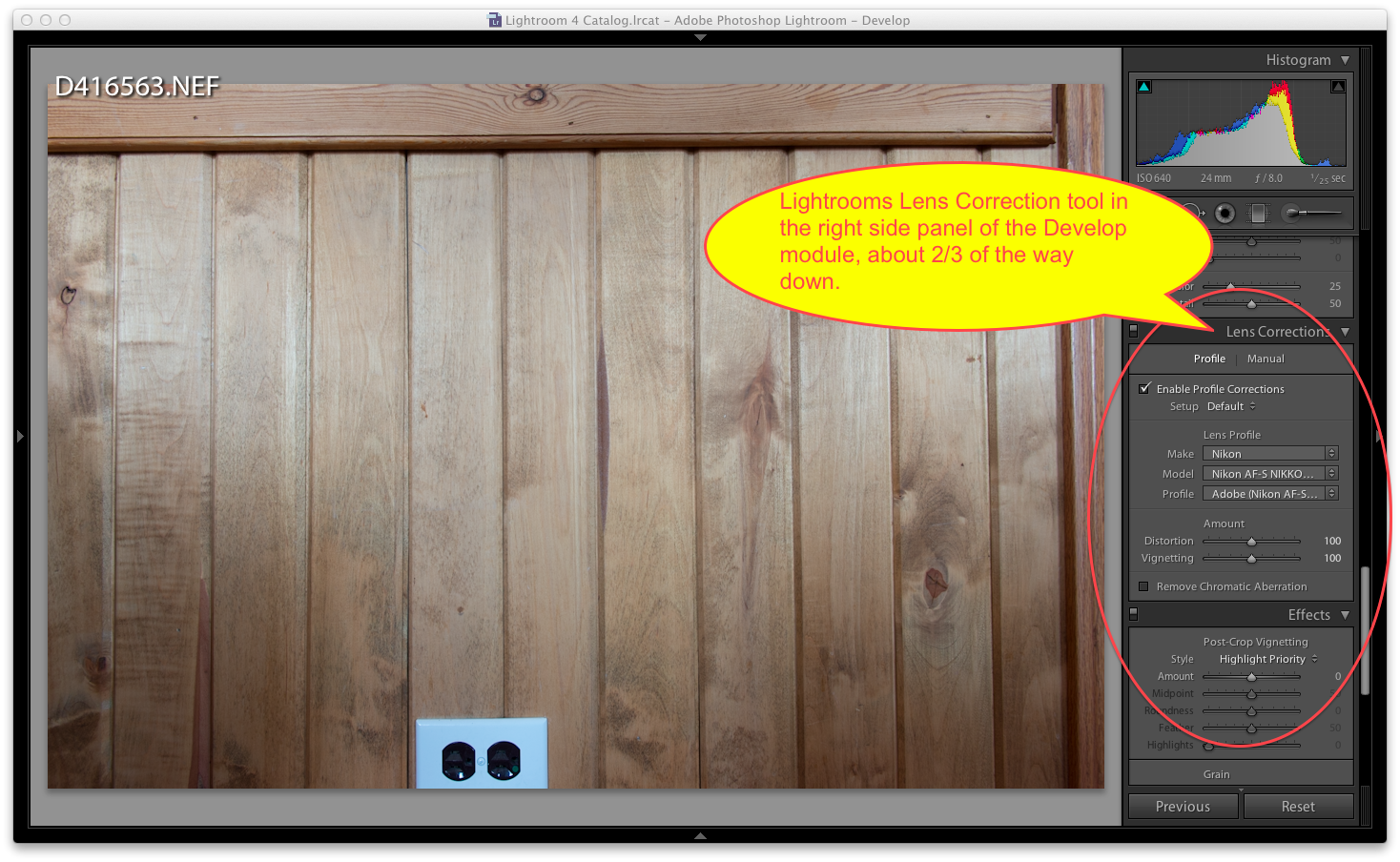
Same image processed through Lighttoom 4’s Lens Corrections module.
Back to my original comparison, and sorry for going a bit off topic but Lightroom’s Lens Correction tool is so impressive I wanted to make sure I mentioned it. Admittedly though, many people do know about this option and it’s one of the reasons Lightroom is so popular. Good job Adobe. The next image is one that is straight out of the camera with the 24mm PC lens. Notice the straight lines and sharpness is superb as well.
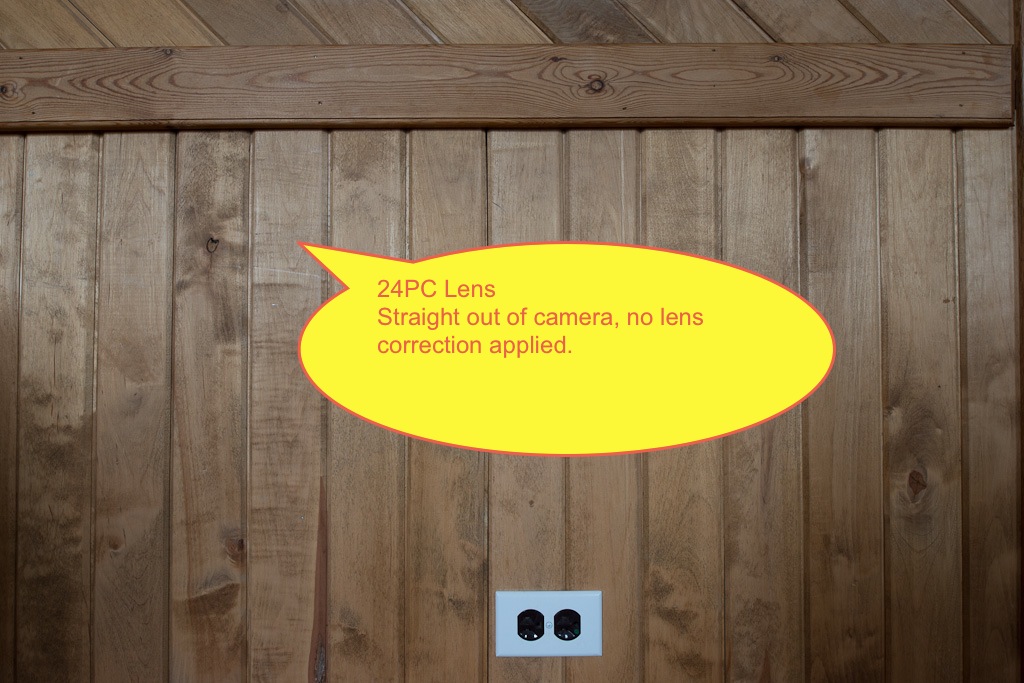
Notice the straight lines and lack of any distortion. I tried running this image through Lightroom’s Lens Correction module and it did make some corrections but it didn’t do it any favors. It may have to do with the fact I couldn’t find the actual 24mm PC lens option. Just the 24mm f2.8 was listed.
For those who are using Aperture we do have a similar option that you can add to Aperture as a plugin called PTLens. It’s a free download for making similar lens corrections as that built into Lightroom 4, however, PTLens’ most notable downside is that it requires each image be taken outside of Aperture and converted to TIFF to make the corrections. The process is rather painless but I don’t like having to convert the RAW image to make the changes. Having to do this eliminates many of the benefits of the RAW format. To say I’m hopeful that an updated version of Aperture adds lens corrections to our RAW workflow would be an understatement.
Finally, the main issue I was interested in testing for was sharpness. I’ve always known the 24-70mm was a fabulously sharp lens but I thought the single focal length of the 24mm PC would hold an advantage. And it did, but not in the sharpness category. It’s main advantage was the lack of distortion. The 24-70 held it’s own in sharpness compared to the 24mm PC or at least it did on my computer screen looking through my 52 year old eyes.
Furthermore, In other tests I’ve done relating to sharpness I’ve investigated the relatively new Nikkor 105mm Macro. It too has Nano Coating and the main benefits I’ve noticed on it and other Nano Coated lenses are in the smaller apertures. Shooting at F16 and F22 in years past created huge, negative quality issues due to diffraction problems. In fact, I just recently sold my Nikon 200mm macro because the image was virtually unusable at F32 and F45. It was so bad I didn’t feel images at those apertures were publishable. This was a major problem since shooting at such powerful magnifications you hope to achieve the best depth of field possible, thus F32 or lower. The old 200mm Macro just didn’t cut it, however, the relatively new 105mm Macro with Nano Coating is one of the sharpest lenses I’ve ever shot. So the engineers at Nikon deserve a huge “atta boy”. Now if they would just build us a set of extension tubes that give us all the electronics our current Nikon cameras require. That’s a subject for another blog post that most likely will qualify as a RANT.
As I’ve mentioned in previous posts, there are more scientifically accurate tests out there. Mine are often what I call real world comparisons. For those who want the absolute most accurate science you can get, visit DxO Labs. They’ll give you the final word on all things related to lens sharpness and digital sensor comparisons. DPReview is also a great site for in-depth tests. I frequent both sites myself but I find it quite rewarding to be able to check some of these details in my own world. It’s amazing what you can figure out with some time on your hands, a lens test chart made from a wall of knotty pine, a tripod, a hot new camera and lenses.