
Two great travel lenses Leica 12-60mm and Olympus 12-100mm to foil carry-on police
As traveling photographers, we’ve all been there. “There” is the point in the line where the gate agent looks you straight in the eye and asks you to place your carry-on in the make-believe overhead bin that determines its size. It’s never fun and always stressful. It’s been a problem since I began flying over 40 years ago.

A man passes along the waterfront in Dubrovnik, Croatia. Lumix GH5 with Leica 12-60mm, handheld 1/3 @ F2.9, ISO 1250
The dreaded size and weight restrictions came to a head on my recent return flight from Europe on Air France. My beloved Lowepro Pro Roller attracted the attention of the carry-on police who demanded I hand it over for a size check. The dimensions were fine, but the weight triggered bulging eyes and an authoritarian complex from the gate agent. Even with Micro Four Thirds gear, I was busted. Below is a short video of what was inside that made her crazy.
Those of you who travel with us know that part of the pre-trip process involves me giving everyone a call before any particular adventure. The goal is to check with each NE Explorer to see if they’re comfortable with the equipment they’re bringing. The number one concern I hear about is whether their camera bag is going to make it onboard. Flying is getting ever more difficult and taking less camera equipment is something to seriously consider.
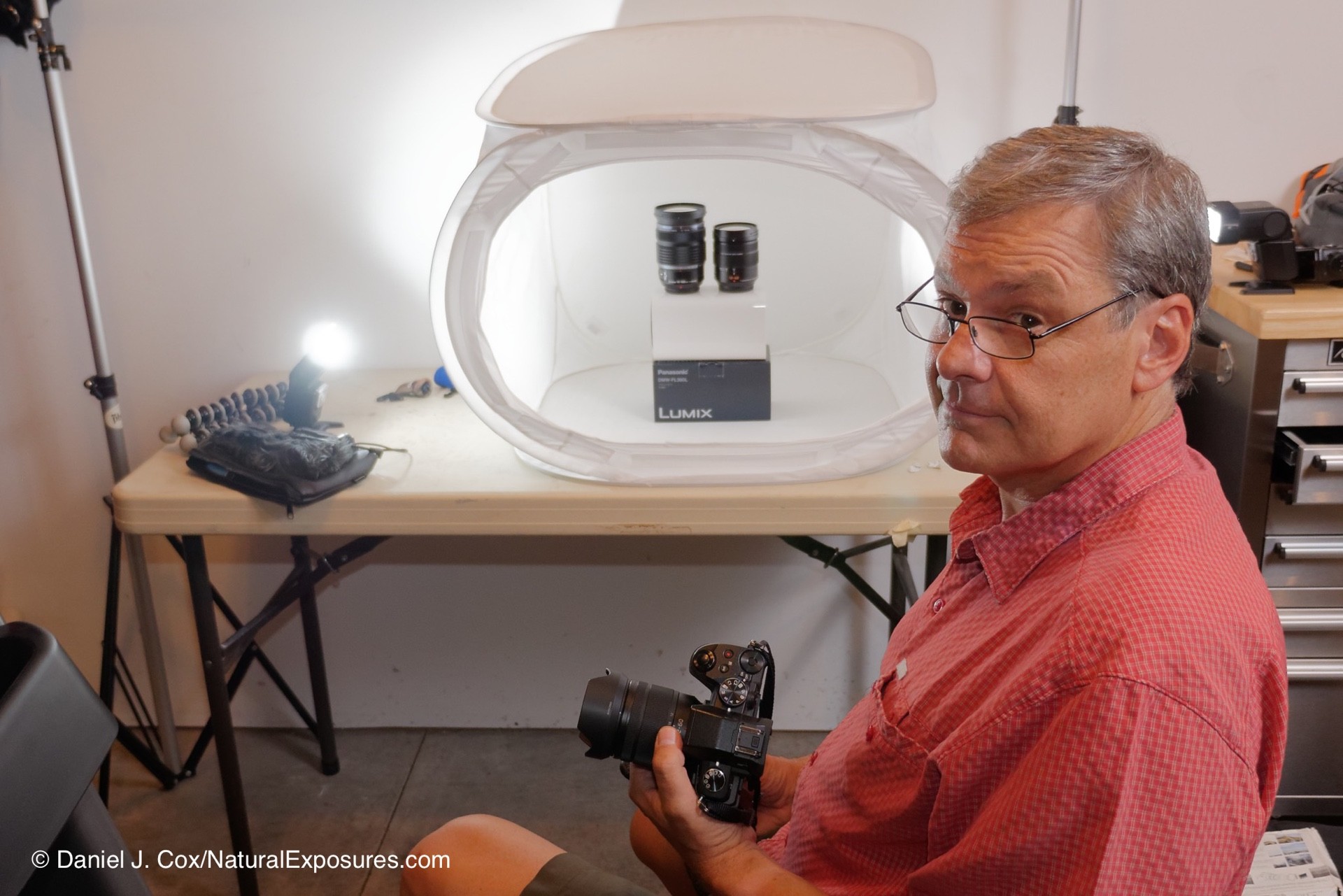
In my humble little studio shooting a comparison photo of the two lenses.
With that in mind, I want to share my thoughts on two new lenses that could be all you need for travel photography that doesn’t involve wildlife. The first one is the new Leica 12-60mm F/2.8-F/4, and the second is the Olympus 12-100mm F/4. For those new to Micro Four Thirds cameras–all lenses are multiplied by two. So the two lenses mentioned above are actually 24-120mm F/2.8-F/4 and 24-200mm F/4 respectively. Both offer an extremely handy range, with the Olympus having a bit more zoom, but the Leica having a faster aperture on the wide end.

Looking down into a lavender plant in Provence, France. This was shot at 1/4 @ F/22. I purposely shot a slow shutter speed and zoomed the lens during the exposure, adding a pop of light from the G85’s built-in flash to help stop some of the motion. No tripod used.
During my recent two months of photo tours in Europe, I shot the new Leica 12-60mm extensively. In fact, it replaced my longtime favorite 12-35mm F/2.8 which I left at home. One of our Explorers, Fred Kurtz, had the new Olympus. So it was quite interesting to have both lenses available to see how each performed. Both of us came away feeling as though the possibility of traveling with one lens might just be upon us.

The famous white horses of the Camargue, France. Shot at 1/1600 @ 6.3 ISO 320
Durability and Build
Before getting into the specific differences I want to mention that both lenses are incredibly well built—made of metal—and each feels extremely durable and robust. However, based on my long term use, the Lumix/Leica lenses seem to hold the durability advantage without the excessive weight Olympus builds into their professional lenses. Olympus lenses give the impression of impeccable build quality, but unfortunately I’ve had more issues with the Olympus lenses I own than my Leica/Lumix lenses.
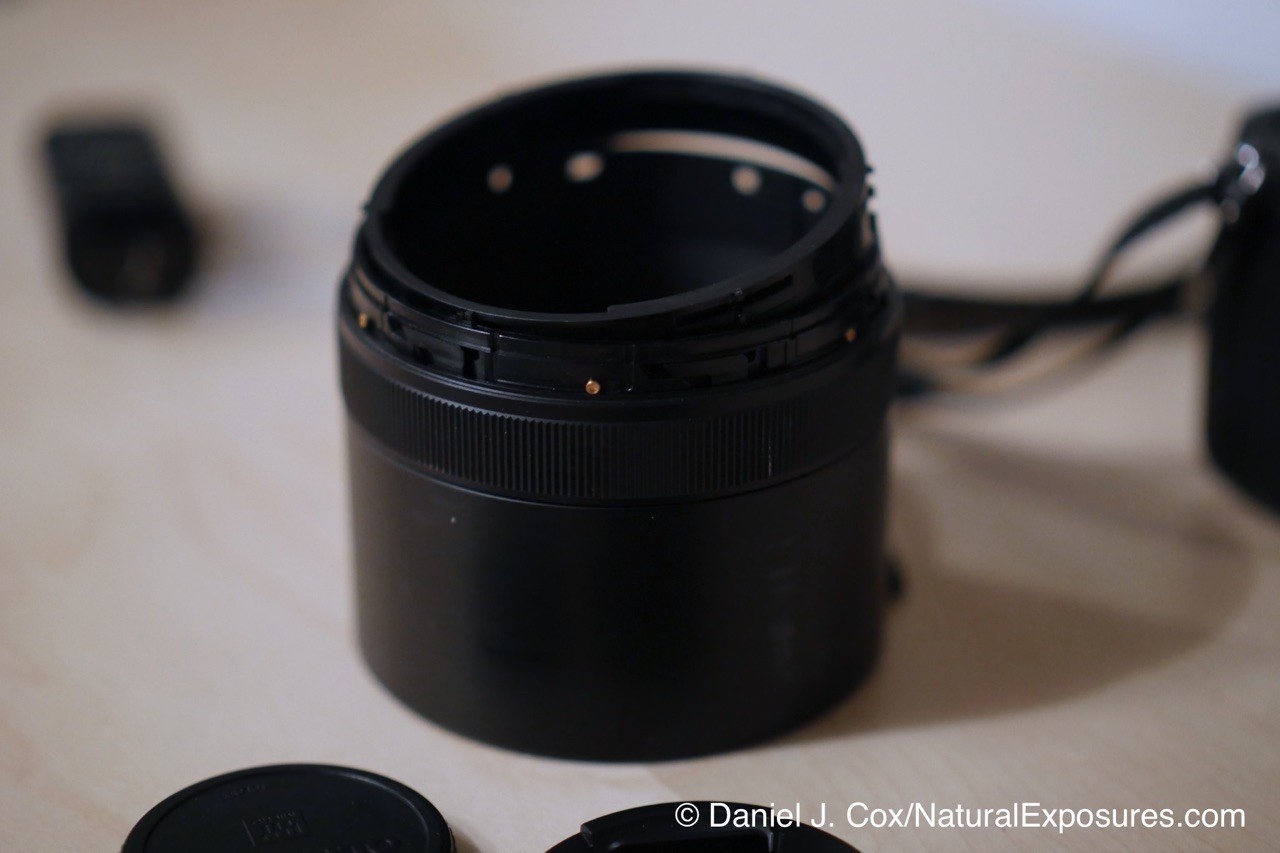
Olympus 40-150mm lens shade that has come apart on me three different times. Two times fixed by Olympus. Now just sitting in my studio.
I use the word ‘seem’ due to a couple of problems I’ve had with Olympus lenses that have either lost their screws, or in one case had a lens hood come completely apart. The lens hood was part of the Olympus 40-150mm and it’s happened three times. It’s been fixed twice but after the third time, I now just leave it back in the studio.

Sunset with bush plane on Island Lake, Minnesota. G85 with 12-60mm 1/160 @ F/2.8 ISO 160
Both lenses are advertised to be splash, dust, and freeze proof. Although I can’t comment on any of these features regarding the Olympus lens, I can offer some in the field experience with the Leica. I’m finishing up this blog post while on our Alaska Brown Bear Tour and we’ve had a lot of rain this year. I’ve purposely not used a rain cover during any of my shoots. But keep in mind we’ve not spent any serious amount of time in the field while it was actually raining. I have had my equipment exposed during
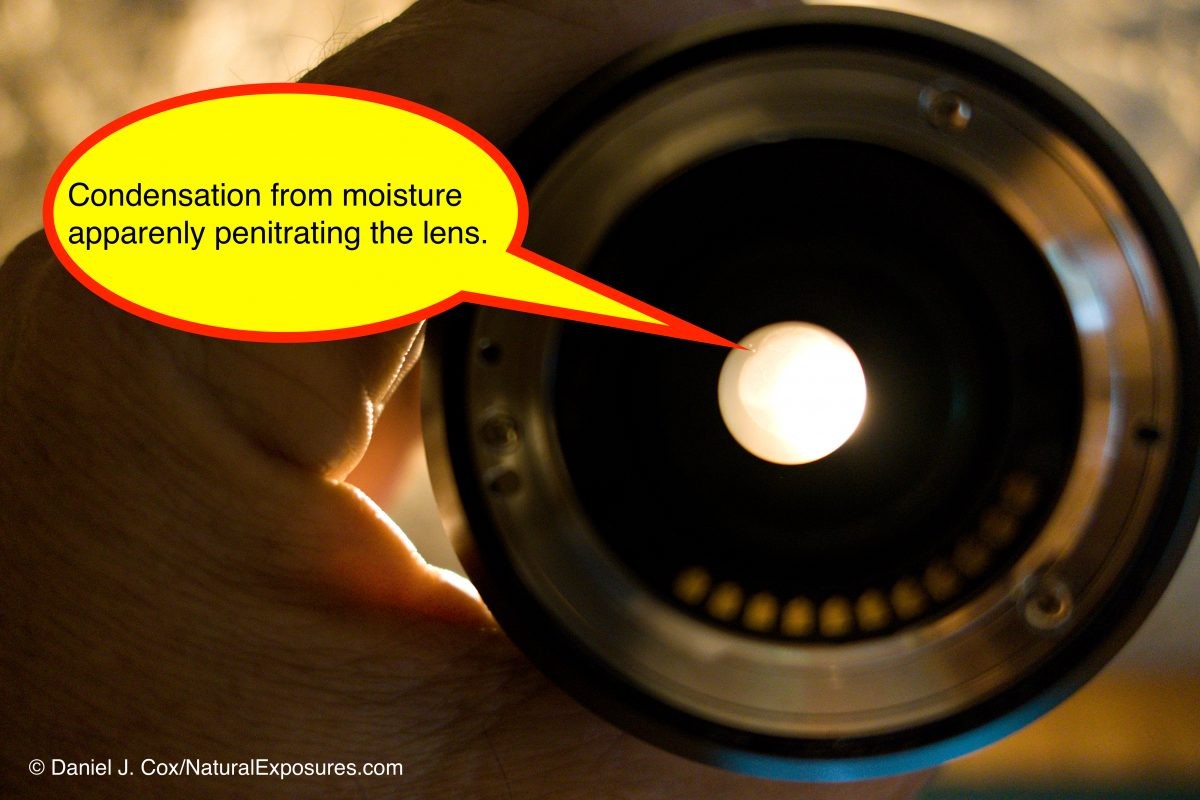
Rainwater condensation in the Leica 12-60mm zoom.
some minor sprinkles but packed it away before the hard rains would start. So in short, my GH5’s and two lenses, the Leica 100-400mm and the 12-60mm, have had some exposure to wet, damp weather. Unfortunately, one afternoon while shooting some of our NE Explorers having fun at our annual Brown Bear Hat Party, I noticed condensation on the inside of the Leica 12-60mm. I have to say I was a bit surprised. I brought this to the attention of the Lumix team and they’re looking into it. I’m confident I must have a defective copy as far as weather sealing goes. The good news is, when the Lumix engineers hear of a problem, they fix it.
One Lens is a Bit Larger Than the Other
As far as size and range are concerned it’s a little hard to be completely objective since one lens, the Olympus, has 80mm more focal length, and it may be that extra reach that creates the perception it’s so much larger. To be fair, I checked each lenses’ weight and we’ll discuss that shortly, but I can tell you now, perception and reality are a bit further apart than what I first thought. So what are the obvious differences? Zoom range, size and weight, maximum aperture, close focusing, manual focus, and price.

Seascape with the local lighthouse just off the coast of Rovinj, Croatia. Lumix GH5 with Olympus 12-60mm handheld 1/25th @F/7.1 ISO 320
Zoom Range
Both lenses offer what is basically several lenses in one. As I mentioned above the Olympus gives us more reach—out to 200mm—but both give us 24mm on the wide end. For me, 24mm is a must have. There are many zoom lenses out there–the Lumix Vario 14-140mm is one example– that are only 28mm on the wide side and though that’s close to 24mm, but not close enough. I’m a huge fan of 24mm. If I had to choose one wide angle range it would be 24mm. There are numerous lenses that go wider and there are times I love the wider look, but 24mm gives you wide enough without the huge distortion effect super wide lenses are known for. That’s not to say there isn’t a need for even wider than 24mm, but if we’re making a decision to take less equipment, these two lenses offer what I feel is the perfect wide range that’s optimal for most situations.

An oil rig near Medora, North Dakota. Lumix GH5 with Leica 12-60mm, handheld at 1/10th @ F/3.7 ISO 500
When it comes to the long end, 120mm on the Leica and 200mm on the Olympus, both give us more range than many are used to. Or maybe I should say, what I’m used to. I’m guessing the reason Panasonic created this lens was the extreme popularity of something similar from both Nikon and Canon. Nikon has proven that when done right, meaning very good optics, this lens range 24-120mm is a great all around travel choice. Olympus took this to another level and is the only manufacturer that I know of that’s attempted such a long range (200mm) in one lens.
Both of these optics are exceptionally sharp so the quality of your images will certainly not be any reason to decide to choose one over the other.
Size & Weight
When comparing these two lenses size and weight are two things that jump out at you. With the Olympus having a longer range, it stands to reason it’s going to be larger. The photograph below gives you a visual of how the two compare side by side. Both are the lens only, without the lens hoods attached. Lens hoods add a lot of bulk but generally not much weight since most are made of plastic. I felt a comparison image without lens hoods is more effective for giving the true size difference. The image below is one I shot in my studio.
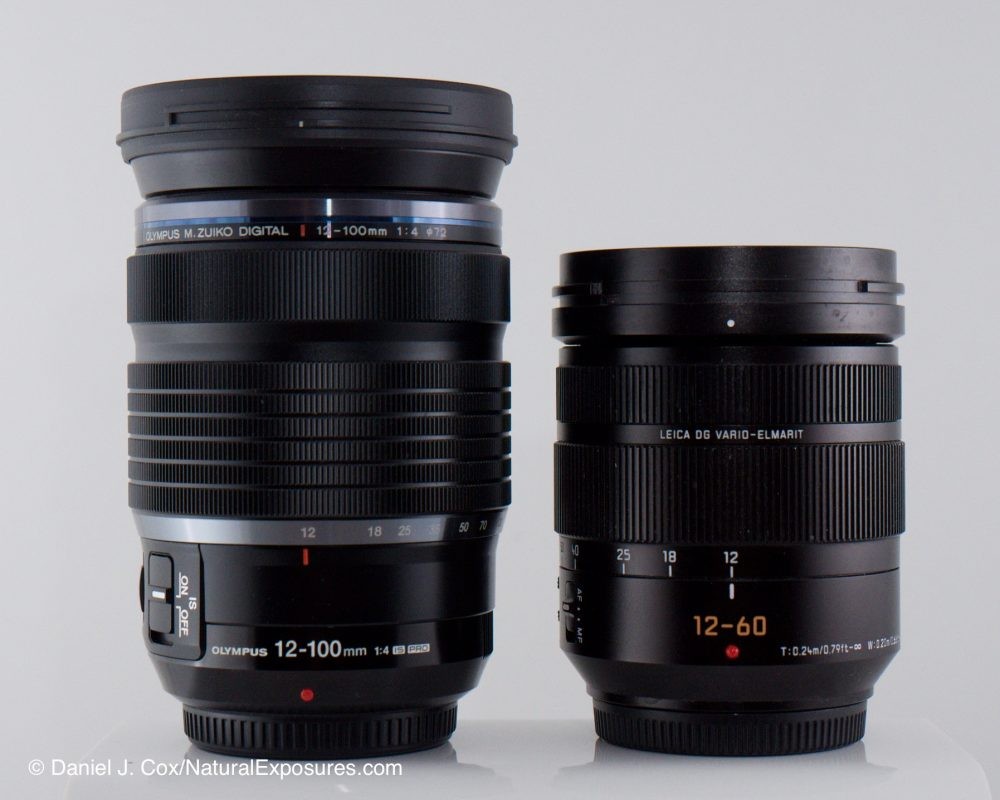
Olympus 12-100mm on the left and the Leica 12-60mm on the right.
As far as weight is concerned the Olympus 12-100mm F/4 weighs in at 1.23 lb (561 g). The Leica is almost a half a pound lighter at 11.29 oz (320 g). That seems substantial unless you remember the Olympus gives you at last one more lens in the overall package. So to be fair you would need to add another entire lens to the scale and combine the weight of the Leica and second lens to their weight. Doing so would most likely make the Leica with the second lens considerably heavier than Olympus alone.

A beautiful home on Island Lake, Minnesota. Lumix G85 with Leica 12-60mm, handheld at 1/6th @ F/2.8 ISO 1250
Whether the final weight is considerable or not depends on which body you pair each lens with. If you want to go as light as possible with all Lumix gear, you may want to pair the Leica 12-60mm with the G85. If so, you get a lens and camera weight of 1.8 lb (825 g). On the other hand, the Olympus OM-D EM-1 Mark ll with the Olympus 12-100mm attached is 2.5 lb (1135 g). So overall the Olympus comes in quite a bit heavier but you get a bit more reach. The next question you have to ask is if you need that reach. One last thing to consider is the possibility of pairing the Leica lens to the more pro-oriented body, the GH5. If you do that, you get a package that weighs 2.3 lb (1045 g). Just two ounces less than the Olympus and OM-D EM-1 Mark ll with the 12-100mm attached. Admittedly, the Lumix GH5 is larger and heavier than the Olympus OM-D EM-1 Mark ll, but I find it much easier to handle. The extra size of the GH5 is not a real issue since the big difference for saving weight and size is in the lenses.

Setting sun shines through lavender plants in France. Lumix GH5 with Leica 12-60mm 1/60th @ F/22 ISO 200
So as far as weight and size, the Olympus 12-100 is most definitely larger and somewhat heavier, but when comparing all the possibilities, it’s not as big of an issue as I thought it might be. That said, if you’re happy with 120mm at the long end and you want to go as light as possible, the Lumix G85 and the Leica 12-60mm is the way to go. During my recent two months in Europe, I found the 12-60mm to be exactly what I needed most of the time. I will admit, in a perfect world, we all want a bit more range. I’ve never met a photographer yet that didn’t want something more than what he/she was shooting. In the end, you have to make the call on the tradeoff between weight and reach.
Maximum Aperture of F/2.8 Can Be An Advantage
The next comparison I want to discuss is the differences between the fixed F/4 aperture of the Olympus and the variable aperture F/2.8-4 of the Leica 12-60mm. In a perfect world, many photographers feel a fixed aperture through the entire zoom range is beneficial. I used to think the same, but with today’s camera technology it’s no longer an issue—most of the time. If you’re a pure manual shooter, variable aperture lenses can be a pain.
The reason variable apertures are a problem for manual exposure photographers relates to light transmission entering the lens barrel. Quite simply, the longer the barrel the more difficult it is for the light to get to the sensor. As a variable lens extends or retracts, the amount of light changes. If you’re shooting manual exposure you’ll have to readjust your shutter speed, aperture, or both as you zoom in or out. But that’s only an issue if you’re shooting on manual exposure. Since I shoot Program Mode virtually 100% of the time, the camera easily adjusts with the Leica 12-60mm. Why I shoot Program is an entirely separate blog post. You can read more about my reasons for this at Photography Using Program Mode. P for Professional is my motto.
One of the other things to consider is that even though the 12-60mm has a F/2.8 aperture at 12mm (24mm equivalent), F/2.8 eventually changes to F/4. Thankfully that doesn’t happen until the lens reaches about 52mm. In short, the variable aperture is not a problem in my opinion and having F/2.8 as an option is one major advantage of the Leica over the Olympus.
Not Officially Macro Lenses But Both Focus Incredibly Close
Though neither of these optics is considered a true macro lens, both of them could suffice for macro work for most people. I regularly found myself using the Leica when I wanted to get very close to my subject. I did have the Leica 45mm macro in my camera bag, but it was very handy not to have to change lenses when I wanted that macro look. The specs for the two lenses show that the Leica can focus in as close as 7.87 inches (20 cm) and the Olympus 5.91 inches (15 cm). Not a huge difference but between the two, the Olympus is going to get you slightly closer.

Chokecherries in Montana. GH5 with Olympus 12-100mm lens ISO 400
Manual Focus
Both lenses are very fast and very accurate when used with auto focus. Each also has the ability to be set to manual focus. On the Leica, it’s a simple switch of the back AF lever to set the lens to manual focus. On the Olympus, you simply pull the focus ring backward which releases a clutch-like mechanism that initiates manual focus. This type of system seems quite clever at first, but after using it for some time, I found myself regularly accidentally changing the lens to manual focus as I reached into my bag, grasping the lens and pulling my camera out. Many other Olympus lenses work in this manner and one way to fix this issue is to put a small piece of gaffers or duct tape on the focus ring. I’ve done just that on two Olympus lenses I own and it stops the lens from being disengaged when you least suspect it.
Cost
Between the two the Olympus is more expensive at $1299.99US. The Leica is a bit more affordable at $997.99. Not a huge difference but $300 will be a deciding factor for many photographers.
Special Thank You to Natural Exposures Explorer Fred Kurtz for sharing a great collection of images he shot with the Olympus 12-100m zoom.
Conclusion
Both of these lenses are terrific new additions to the world of Micro Four Thirds lens choices. For me, the 12-60mm has become my go-to lens for almost all my travel photography, now coupled with the new Leica 8-18. The super wide 8-18mm allows for a considerably wider views of interiors I often shoot in Europe. But overall, during our last trips that included Croatia, Slovenia, and France, almost 95% of all my pictures were taken with the Leica 12-60mm F/2.8-4. Whether you decide to buy the Leica or the Olympus, it will most likely depend on how light you want to go since the Leica is a bit lighter than the Olympus. I’ve carried both and I will admit that I feel the Olympus more when it’s on a camera hanging from my shoulder. You could make the argument that having that additional reach of the Olympus’ 100mm (200mm equivalent) that you have a perfect combination when pairing it with the Leica 100-400mm. But I’ve found I don’t miss the additional 80mm, and giving that up for the lighter weight and bulk seems a worthwhile trade off.
The last thing to consider is how important Dual IS is to your shooting style. This is becoming an important issue when making the decision to mix and match our lenses from these two great companies. For those who don’t know, when adding an Olympus lens to a Lumix body, you give up the Dual IS capabilities we have with a Lumix lens on a Lumix body. Just last week Lumix announced a firmware update for the 12-60mm which I immediately downloaded. A quick test showed the amazing ability to shoot handheld at 1.3 seconds at 12mm (24mequivalentnt) using Lumix’s Dual IS. I wouldn’t be able to do that with an Olympus lens on a Lumix camera.
Image Stabilization test, new firmware for 12-60mm. I shot this from my kitchen counter just after the new firmware update, handheld at 1.3 seconds @12mm (24mm equivalent).
In theory, being able to put an Olympus lens on a Lumix body is a great idea, but I’m starting to think that losing the Dual IS is not worth the benefits. Part of what I used to have to consider was whether Lumix had the particular lens I needed. That’s no longer much of an issue. Most of the Lumix lenses are matching Olympus and vice-versa. So the days of me thinking about purchasing Olympus lenses seem to be fading into the rearview mirror.
In the case of these two lenses, they don’t match each other perfectly but it’s close enough. They are both extremely sharp. However, the lighter weight and the fact I get Dual IS are two of the main reasons I’ve chosen the Leica 12-60mm. Either way, they are both great lenses. The final decision is obviously yours.
Special Thanks to F-11 Photo in Bozeman, Montana for letting me borrow the Olympus 12-100mm for studio photos. Can’t thank Marsha enough for lending me gear I don’t own. For your Olympus or Fuji needs you can always drop F-11 Photo a line on there website at www.F11Photo.com.
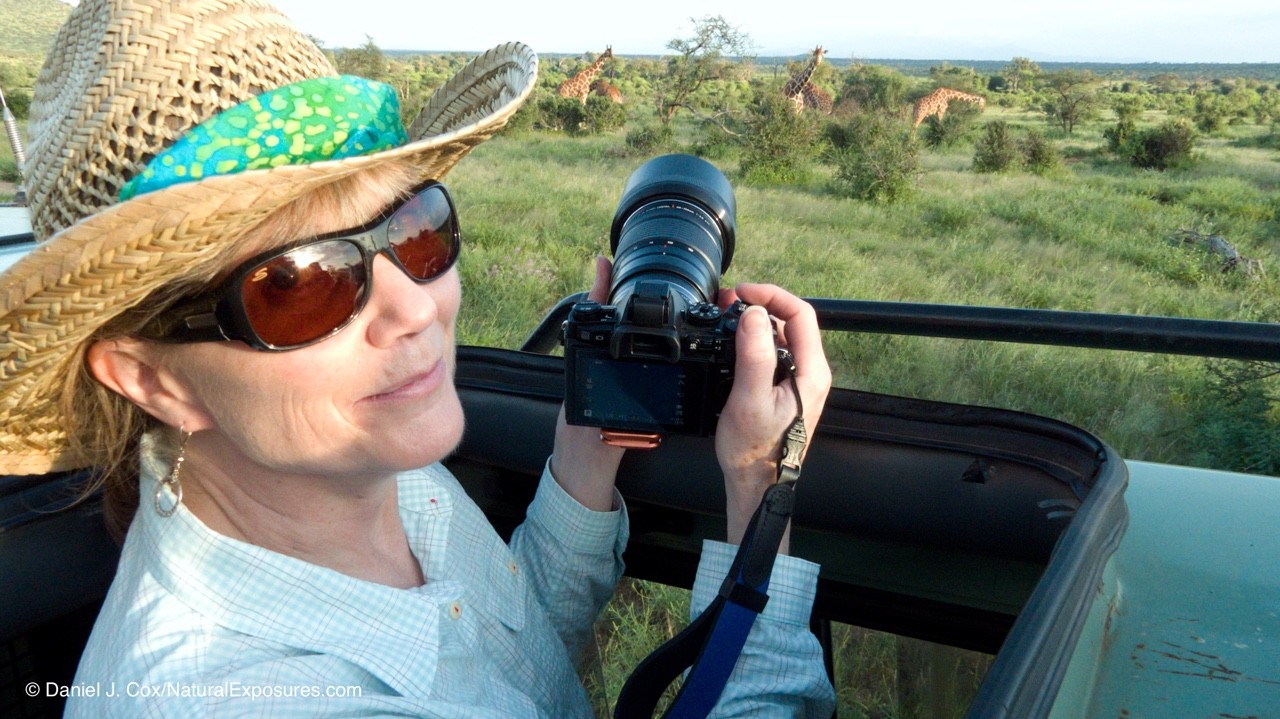
Marsha Philips of F-11 Photo on safari with Natural Exposures Invitational Photo Tours. Kenya
As I’ve suggested in the past, support your local camera dealer if you have one. If not, support a smaller camera dealer like the folks at F-11 Photo in Bozeman, Montana. We need the little guys and gals in our life.
Luminary Disclaimer
In the spirt of complete transparency I want all my readers to know that I am a Lumix Luminary. That means I get paid a small stipend for writing about a system I absolutely love. That said, I want you all to know there is no amount of money more important than my integrity. Much to the chagrin of my Lumix colleagues, I often point out the bad with the good regarding Lumix technology and their camera gear. My belief is honesty and truthfulness will not just help you, but it also helps a company I love to work with. To that end, it’s full steam ahead telling it like it really is.
Daniel J. Cox