

Testing the New Nikkor 80-400mm Zoom Lens
I’ve been meaning to write this post highlighting Nikon’s newest zoom, the updated 80-400mm, for quite some time. Unfortunately a lot of travel has kept me from being able to run the proper tests, but finally I was able to put Nikon’s newest zoom through its paces, then sit down and write about the results. In short, it’s spectacular! The new Nikkor 80-400mm zoom that was recently updated is officially titled the AF-S Nikkor 80-400mm f/4.5-5.6 ED VR, as opposed to the older model listed as the AF VR Zoom-Nikkor 80-400mm F/4.5-5.6 D ED. I highlight these two exact names as they are shown on the Nikon website so you won’t get them confused. I’m a firm believer the extra $1000 (U.S.) required for the new lens is well worth the cash.
Photo Tip:
Watch for my upcoming article in the October issue of Outdoor Photographer on zoom lenses. The new Nikon 80-400 is a big part of that story and there will be numerous published images showing the quality of this lens.
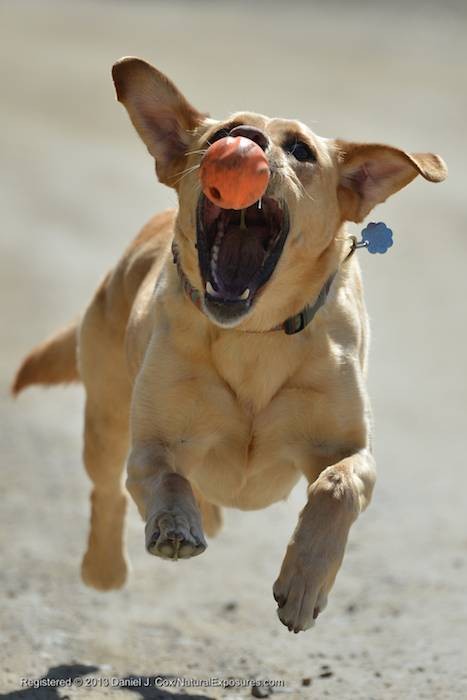
 Anne gets some air as she goes in for the grab on a flying orange ball. Montana
The old 80-400 has been around for something like 12 years now. And for all these 12 years I’ve hoped beyond hope that Nikon would update the old lens and make it something I was proud to recommend. Many of the folks I run into in the field or who travel with us on our Invitational Photo Tours don’t have the desire to purchase or carry the expensive, heavy, and legendary 200-400mm F/4. That was really the only option in this zoom range for serious high quality images. But with the release of the new 80-400mm, Nikon has finally answered my wishes and made what I believe will become a new legend in Nikon optics.
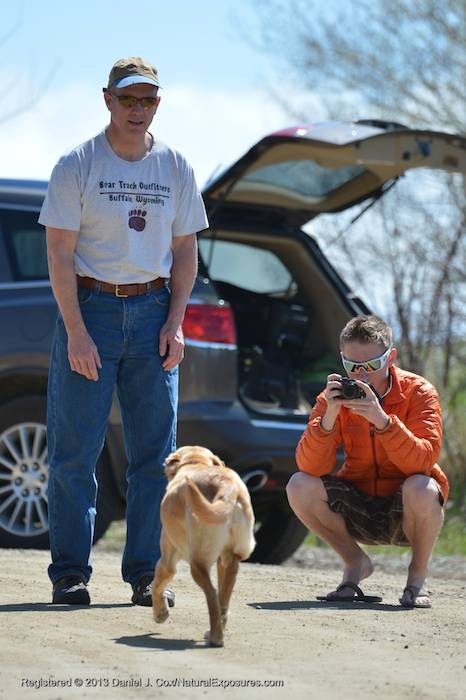
 My buddy Bill Buckley and godson Colter on the receiving end of the dog fetching exercise. Montana
Before I left for the Galapagos this past winter, Nikon was kind enough to send me the new 80-400mm to try. I bought it as soon as I got home. It is a stellar lens for sharpness, size, and ease of use. But most importantly, sharpness. The old 80-400mm left a lot to be desired when it came to getting crisp razor-sharp images. The details just weren’t there in the old lens, especially at the far end of its range of 400mm. At 300mm and below it wasn’t too bad, but beyond 300mm I was always left wanting better image quality. Nikon has changed all of that.
The focus ring is smooth as silk and would be a joy to use if I ever had a reason to manually focus. But I almost never do. Even so, I’m glad it’s still there. The focus ring has a different pattern than the zoom and is located closer to the camera so confusing the two isn’t easy. Nikon has included a substantial tripod collar and mount that is effortlessly removed if needed. The collar allows for easy rotation from horizontal to vertical when on tripod and is relatively smooth. It’s not quite like the 200-400mm but more than acceptable. For the front end of the lens you’ll need to purchase 77mm filters, if you choose to use them. I find them quite helpful since many of Nikon’s top optics are the same size. There’s a lens creep, locking switch on the side of this lens as well, so it’s not constantly extending itself as you walk with it carried over your shoulder. Near the barrel lock are the typical AF and VR switches, with the VR giving you the two options of normal and active. Normal for handholding on solid ground. Active for shooting from a boat, plane, or helicopter.
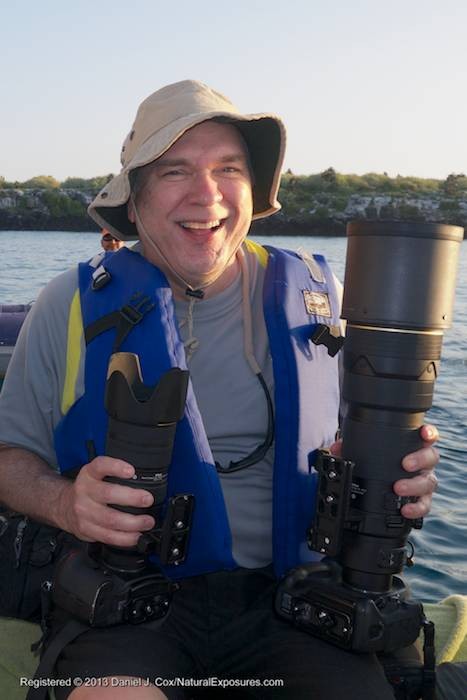
 Good friend and fellow Explorer Fred Kurtz with his two favorite lenses, the 200-400 and 70-200 F/2.8, during his trip with us in the Galapagos.
A good friend and also an NE Explorer, Fred Kurtz, took my recommendations on this lens and went out and bought one. Fred loves to shoot action. He brought the new 80-400mm on our recent photo tour to Ireland, leaving his trusty 200-400mm at home. Like me, Fred appreciates the smaller size and weight of the new 80-400mm, especially on trips that are mostly landscapes, culture, and travel types of photography. On the Ireland trip Fred shot action whenever it presented itself, and on one morning we were down by the coast shooting pictures of flying seagulls, Fred made the comment, “You know Dan I don’t think this lens focuses as fast as the 200-400mm. Seems I’m not getting as many keepers as I do with the larger lens.” That made me think. It hadn’t occurred to me that Nikon might hold back on the speed of AF in the less expensive lens. However, when I thought about it, I had to admit it wouldn’t surprise me that there would be some advantages to the larger, faster 200-400mm, a nearly $7000 (U.S.) lens.
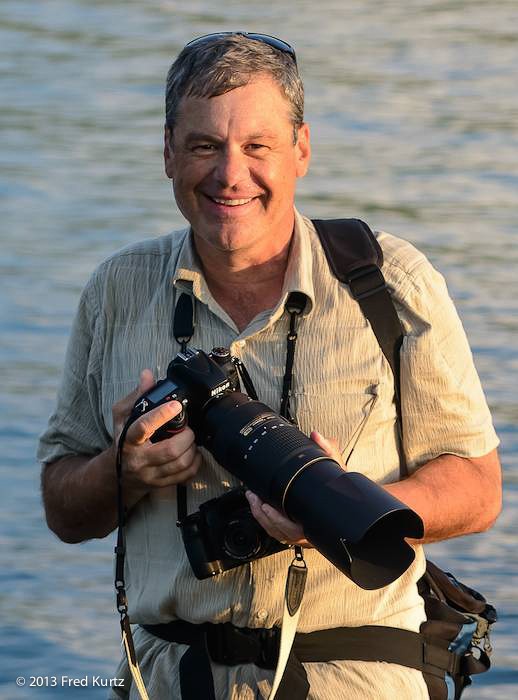
 Me in the Galapagos with the new Nikon 80-400mm attached to a Nikon D600 body. As you can see it’s a pretty small, svelte package. Not me, the lens and camera 🙂
So what’s a photographer to do when confronted with the question of which lens is faster? Well, I went out and borrowed a speedy dog to perform my famous “Speeding Pooch” test that I first introduced awhile back here on the Blog. The idea is to find a subject that moves as much like a wild animal as possible, yet controllable so you can perform some tests. My speeding pooch test consists of a fast dog running straight at the camera while chasing a ball that’s been lobed over my head. Amazingly the toughest part of this setup is actually finding a human that can throw accurately enough so the dog stays in a straight line. No Bill I’m not talking about you. There are others 🙂
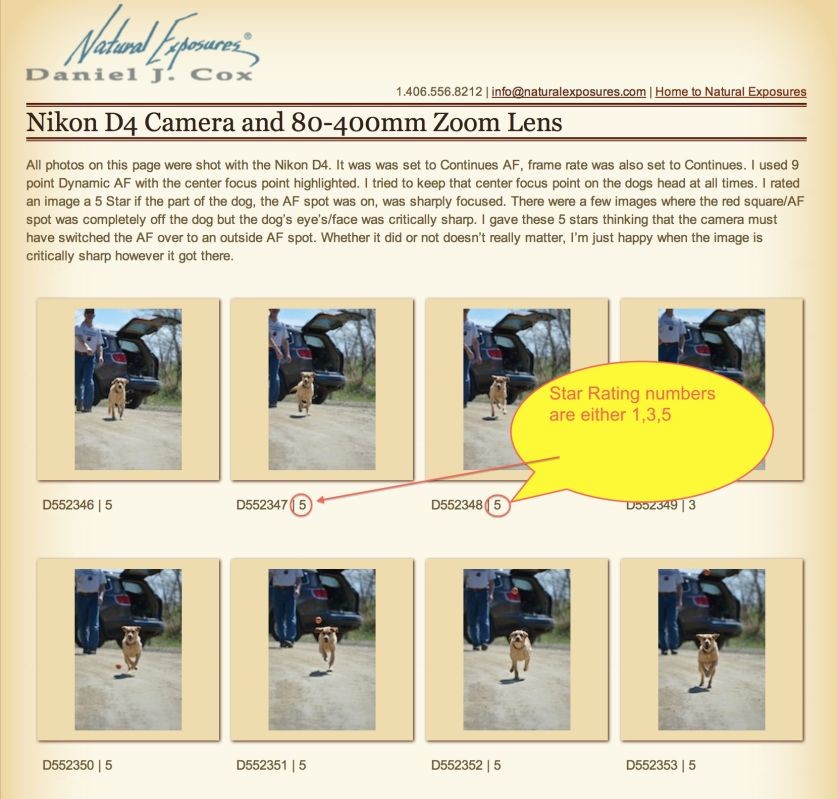
 Star rating system shown on the web page galleries.
For these tests I shot three lenses, the 80-400mm and two different 200-400mm lenses, all of them at their widest apertures so there was no benefit from depth of field. All tests were preformed with the same Nikon D4 camera. It may seem strange that I shot two different 200-400mm lenses but there was a good reason. On the first test I used a 200-400mm that I normally keep tucked away as a spare. My father was borrowing my older 200-400mm and thus I pulled the spare out for the tests. I had run this same test with the older lens my father had and when I checked the results of my speeding pooch with the newer 200-400mm, I was concerned it wasn’t performing like my older 200-400mm. The newer one just didn’t seem to be keeping up.
I called my father and he shipped the older 200-400mm to me in Montana. When I refer to older and newer 200-400mm lenses I should explain, they are both the older, first generation 200-400mm, not the newer VRII updates. I then ran the tests again and my concerns were well founded. For whatever reason, the newer 200-400mm zoom was not doing as well in Predictive AF as the older lens. It just wasn’t nailing the focus like I’ve known my older 200-400mm to do. The newer 200-400mm is now on its way back to Nikon for a check-up.
So, on to the results of the speeding pooch test with the new Nikkor 80-400mm and the older version of the 200-400mm lenses. There are two web galleries of images I’ve created for you to view: Web Gallery for 80-400mm Test and Web Gallery for 200-400mm Test. At the top of each gallery page it states which lens was used. All of the images were rated by the industry standard Star Rating System. I rated each image either 1, 3, or 5 stars. One star represents an image completely out of focus. Three stars tells me it’s almost in focus and could possibly be used if printed very small, but in general, it’s still out of focus. Five stars is a perfect razor-sharp image. Below are the final results in an easy to read format.
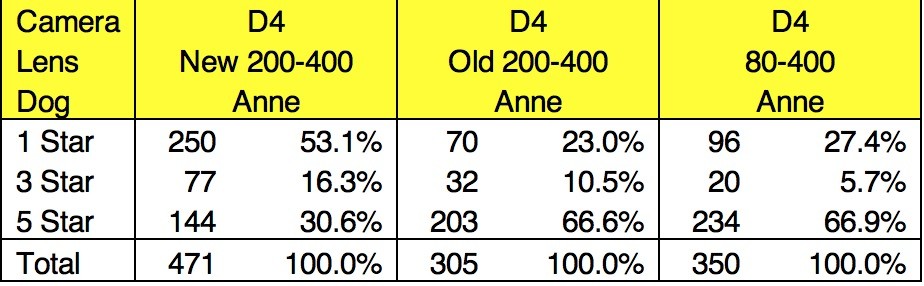
As you can see, the 80-400mm did a great job. Actually much better than I expected. The older 200-400mm did just as I expected, a very commendable job. From the chart above you see the older 200-400 did twice as well as the newer 200-400mm lens. Overall, it seems the 80-400mm isn’t much, if any, slower than the more expensive 200-400mm. That was exciting to see and exactly why we needed to run this test. I was hopeful Nikon didn’t hamper the AF performance in the new 80-400 and from what we can see in the chart, it seems they did not.
To grade the Auto Focus accuracy I used Apple’s Aperture, my standard digital workflow software. Aperture has a great tool that allows me to overlay the AF points the camera recorded in the EXIF data. If the AF spot on the dog was laying over the sharp part of the image, it was 5 stars, even if the face and eyes of the dog were not sharp. It’s impossible to keep the AF sensors exactly on the dog’s face, so I figured if the AF nails the dog’s back, that counts as in focus. Ideally you want the dog’s eyes perfectly in focus and most of the in-focus images were actually on the eye, but I had to take the human element of not bing able to keep perfectly trained on a speeding pooch into account. Thus some images that might look out of focus are actually in focus based on the placement of the AF sensor. Below is a screen shot of what the AF overlay in Aperture looks like.
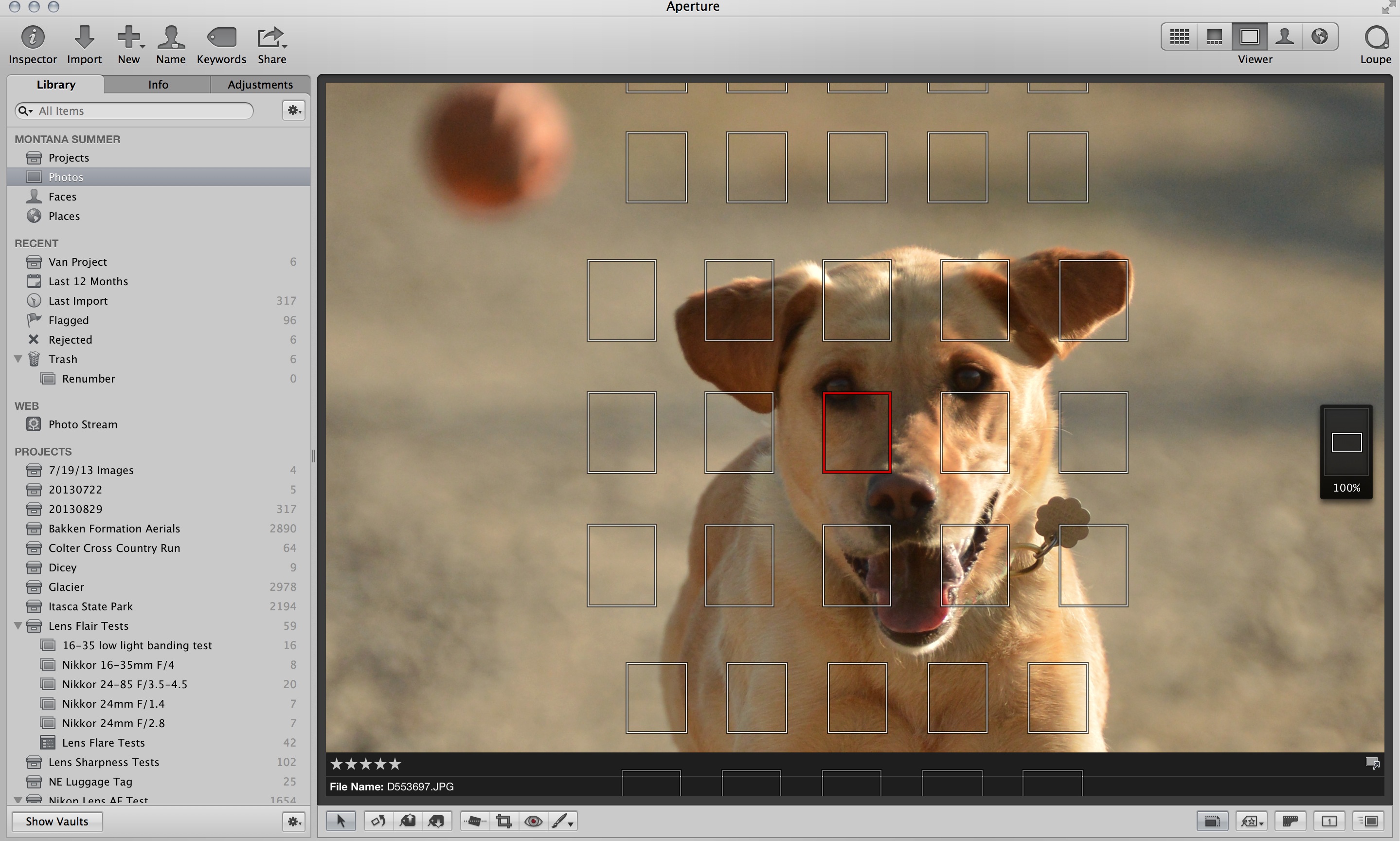
 Notice the red AF point right on Anne’s nose and eye.
Another tool I often check when comparing lenses and trying to find the most optimal settings and technical information is the comparison tool on DxOMark. Here you can find almost any lens made, select them for comparison, and then DxOMark shows you side by side how they stack up to each other. With that in mind I surfed over to DxOMark and selected the 80-400 F/4 VRll and compared it to the closest Nikon 200-400mm F/4 they have data on, which unfortunately is the newest 200-400 VRll. I say unfortunately since I would have liked to compare it to the exact 200-400mm I have which is the older original AF model. That comparison is shown below in a screen shot form DxOMark.
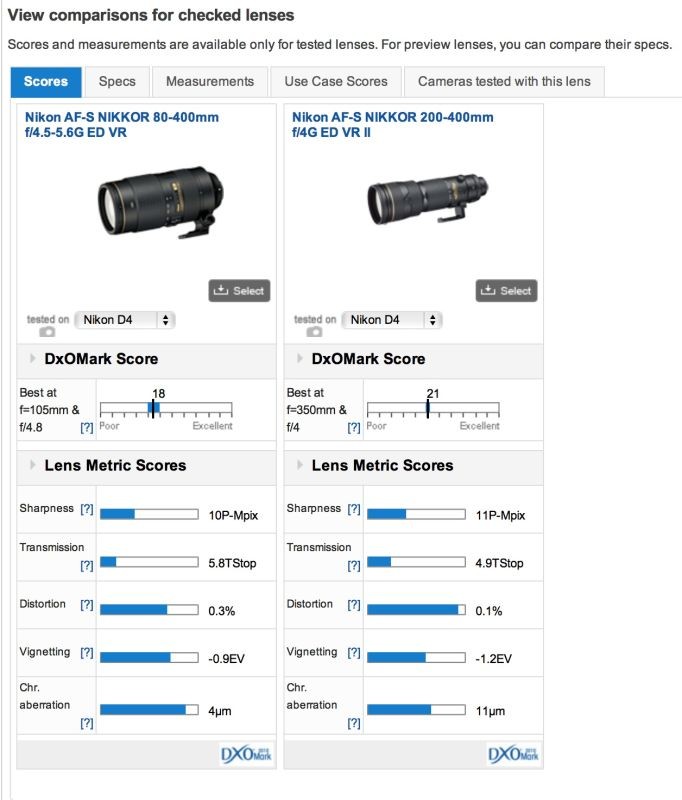
 Side by side comparison of the new Nikon 80-400mm and the newer version of the 200-400mm AF-VRll
One last thing I wanted to check beyond the AF was whether or not vignetting was a problem. Here’s a link to a gallery of images showing real world vignetting issues. I shot this test against a perfectly blue sky at several different focal lengths and apertures. As you can see, there is some vignetting taking place in the photos at 400mm, wide open at F/5.6 and a few other focal lengths, however, this is nothing good software like Apple’s Aperture, Adobe’s Lightroom, or even Nikon’s own Capture NX2 can easily remove. Ideally, it would be nice not to see any vignetting, but in today’s world of digital imaging this is no longer an issue I worry about. Had these images been almost anything but a clear blue sky, you most likely wouldn’t even know the vignetting was there. I haven’t even tried this test with the 200-400mm and I can’t right now, since I’m writing this from Brazil. I didn’t bring the 200-400mm with me for the first part of our Invitational Photo Tours trip to the Pantanal. In its place I chose to carry the new 80-400mm. Our first week we’re flying into a remote area where size and weight are an issue, so for this part of our adventure I brought only the 80-400mm for my long lens. My wife Tanya is meeting us all next week and she’ll be carrying the 200-400mm along with my beloved 600mm F/4. I’ll put the 200-400mm through the vignetting test against the bright Brazilian sky and update this a bit later.
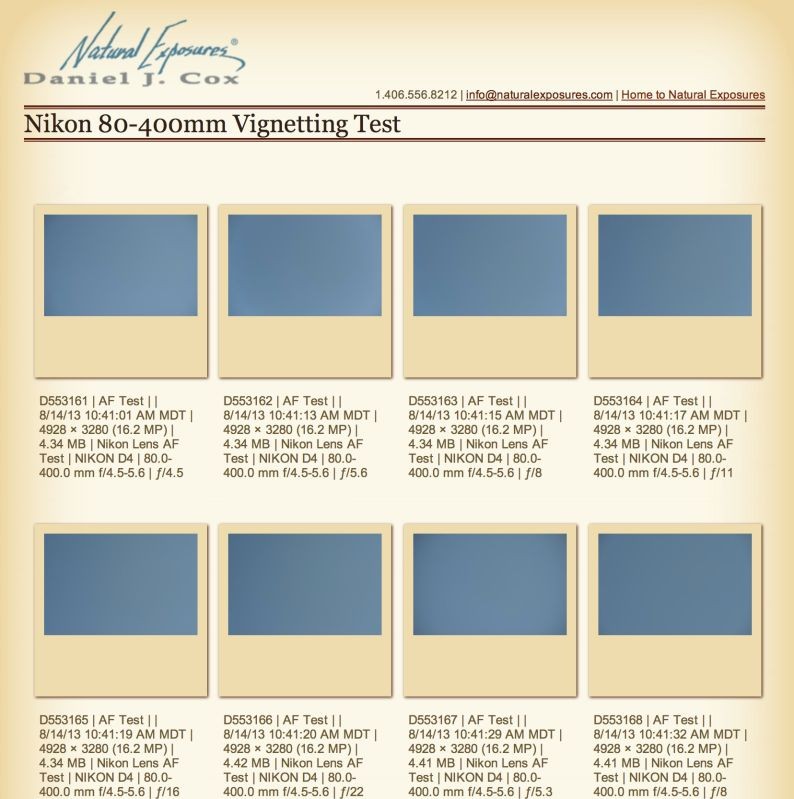
 A screenshot of the gallery page showing the vignetting test.
So there you have it. I hope you find this review useful and if you’ve been thinking of getting a lens with longer reach, this should be high on your list. Yes, at $2700 (U.S.) it’s a bit expensive for some folks, but on the other hand, you only buy it once. With traditional Nikon durability you won’t wear this ultimate optic out and it will give you quality that compares favorably with lenses twice as expensive and mush more difficult to carry around. I highly recommend this stellar new piece of the Nikon full fledged system . I finally have a spectacular answer for our guests who want to move up but just can’t justify nearly $7000 for the larger 200-400mm. This is the lens I’ve been waiting for.
Professional AF Model Gets Hurt on the Job
One final note. One of the dogs I borrowed for this test was a beautiful, 10-year-old black lab named Daisy. She’s actually part of our office crew, and her master is one of our friends at Polar Bears International who we share office space with. I chose not to show any of the tests I ran with Daisy since I had trouble finding a quality thrower and Daisy was all over the place. Not her fault but not a good test either. Even more unfortunate, during my time working with Daisy, she had a fairly serious accident. Daisy ran a half dozen sprints for me and about the time I was going to quit, her owner, master, mom, or the young lady I know as Amy, came out on the lawn to join the fun of Daisy chasing a tennis ball. I asked Amy, “Do you think she’s done? She’s looking pretty tired.” Amy said, “Nah, lets do one more. She loves fetching.” So Amy winds up and fires the ball toward my camera, Daisy took off like a bullet, and half way into her sprint she lets out a loud YELP! “Oh boy, that didn’t sound good,” I said. Amy comments, “Might be her ACL.” And in fact, it was. The next day Daisy visited the vet and they confirm she did indeed tear her ACL. Poor girl. She was having a blast. So once again my father’s advice comes back to haunt me which is, “Don’t ever borrow anything. It’s guaranteed to break in your possession.” Did I ever imagine I would break a dog? No, not on your life. I’ve had many dogs in my days growing up in a family who love to hunt, and though I’ve heard of dogs blowing an ACL, I’ve never seen it. Just goes to show there’s always something new in life to experience. I’m just sorry this one was at Daisy’s expense. She’s such a sweetheart. Needless to say this test was kind of expensive since I’m paying half the vet bill for Daisy’s upcoming surgery. Amy didn’t want me to pay anything but as my father always said, “You break it, you pay for it.”
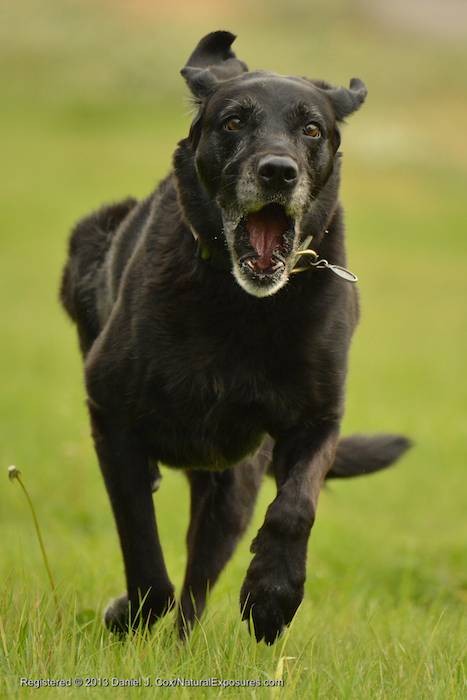
 The exact moment Daisy blows her left rear ACL while chasing a tennis ball. As you can see in this image, she let out a loud yelp when it happened.
Daisy Update:
Daisy went through surgery really well and the vet says she’s a model patient. She was out of the PBI/Natural Exposures office for over a week but just yesterday she stopped by, walked into my little cubicle and gave me a big, sloppy, wet lick across my bare leg. Seems she harbored no ill will to the guy responsible for her recent pain. Based on her enthusiasm, I won’t be surprised if she’s bringing me the tennis ball in the not too distant future. It’s great to have her back.