

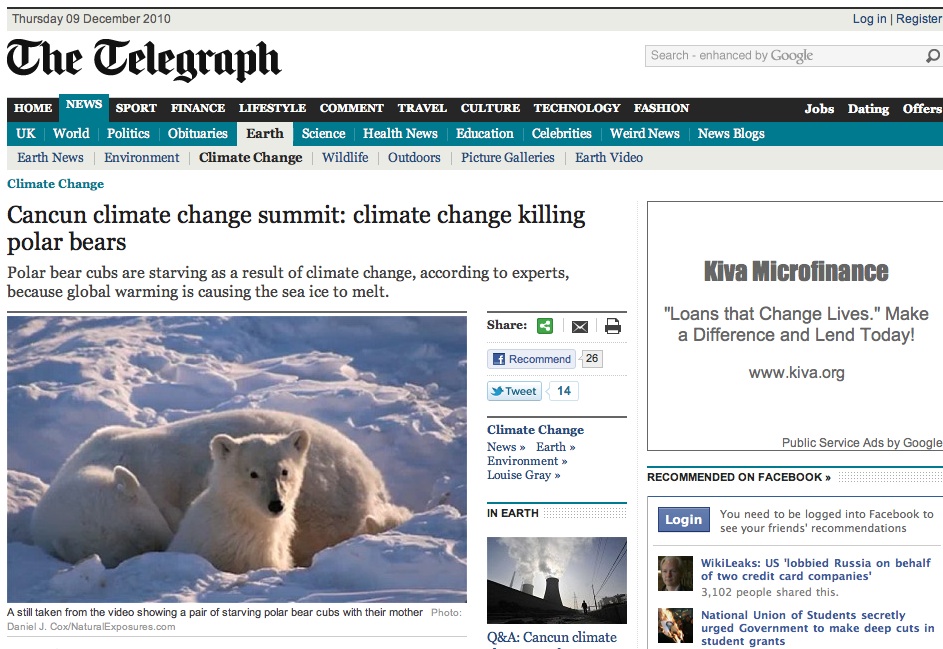
 British Newspaper The Telegraph Runs Starving Polar Bears Video
Recently the British newspaper The Telegraph ran the story of the starving polar bear video I shot last month. As predicted there are lots of negative comments about the validity of the claims of starvation. One blogger, Tom Nelson, laid out some questions that I answered on his website but his blog would not accept the length of the answers. That being the case I wanted to make sure he got the answers he was searching for, so I’m posting them here for all to see. The following was exactly what I typed into his blog comment section—tried to submit but was told it was too lengthy.
You can see his original post at Tom Nelson’s Blog
Tom,
Daniel Cox here, the guy who shot the starving polar bear video. I would like to answer the questions you have.
1). (Your Question) If warming is killing this bear, why is there so much snow around, why is the temperature “well below zero degrees Fahrenheit”, and why is the cub described as “shaking and cold”?
Answer – Fresh water to make snow freezes at 0 C but saltwater freezes at -1.8 C. Yes there was snow on the ground but the bay had absolutely no ice on it. Not sure where you live but if you have ever spent time in the north you know that there can be snow yet no ice. Based on historical scientific data the ice was at least three weeks late and has been for approximately the last five years. This combined with them being forced off the ice earlier adds 3-5+ additional weeks of living with NO FOOD! As far as the cubs “shaking and cold” is concerned this would not be unusual in a situation where the air temperature had begun to drop but the cub had no food since its mother had no nourishment and could no longer make milk for them to nurse. That’s why they died.
2). (Your Question) If the people documenting this situation actually cared about polar bears, and if the bears are really starving, why didn’t they try to feed the bears?
Answer – Yes I do care about polar bears. That’s the main reason 50 % of my time is donated as a volunteer to Polar Bears International. I’ve been documenting this population of polar bears every year except one since 1986. Your lack of understanding why bears cannot be fed suggests to me you are unaware of some of nature’s most basic rules. Rule number 1 for all bears is they cannot be fed. Feeding polar bears would only lead to them becoming a problem to humans in the remote native communicates they come into contact with.
3). (Your Question) When another bear shows up, why doesn’t that one look like it’s starving?
Answer – Not all bears have starved, yet! The other bear you refer to was most likely a younger adult that did not have the burden a female with two young cubs is encumbered with. When you have no food for yourself and yet you still have to produce milk for your cubs, eventually the milk dries up. With no milk, starvation for the cubs ensues.
4). (Your Question) The mother and cubs are shown laying around in one spot. How does that qualify as “desperately searching for food”?
Answer – These polar bears have obviously hit a wall. Though they are not running all over the tundra as your question suggests you would like to see to satisfy your concern that they truly were “desperately searching for food,” they are—like all bears—constantly searching for their next meal. However, at the same time they’re also trying to conserve every ounce of energy they still have left. For the cubs that energy ran out two days after this video was shot. Also keep in mind that the video portrays a short 3-4 hour window into this event. At the time I shot this the bear family was resting and for the cubs it was the last time.
Finally, I should mention that this is the second extreme event I have witnessed in the last two years of documenting the polar bears of Western Hudson Bay. Last year it was a large male who predated and cannibalized a cub of the year. That was one of either seven or eight predations—a record—of young cubs that took place in this area in 2009. Both cub losses, this year’s and last, fall into the category of what polar bear scientists have predicted would start to happen as this group of polar bears starts to decline due to ongoing food difficulties. You can see the photos from last year’s event by clicking here. Amazingly, in 20+ years of working in this area I had only ever seen one cub death. Now in the last two years I have seen two. Polar bears are the proverbial Canary in the Coal Mine. If they can’t cope with the speed of change in their environment, what makes humans think we can do any better? Thankfully there is hope. Stop by www.polarbearsinternational.org for ideas on how we can all do our part to save the ice and the polar bears who need it to survive. For a more complete story about what happened you can visit my blog at Polar Bear Caught in Act of Infanticide and Cannibalism.