

I recently received a pair of Panasonic Lumix GH4 cameras and I couldn’t get them in my hands fast enough. They’ve been in the wild so to speak since about last Friday, April 25, 2014. Ray Norouzi from Samy’s Camera in LA was fast out of the blocks and called me as soon a they arrived in the US. I immediately bought three, two for myself and one for my mother in law. Yes, my mother in law who is running a non-profit that rescues abandoned dogs in the Everglades of Florida, but that’s a whole different Blog post. It’s an amazing story, to be continued.
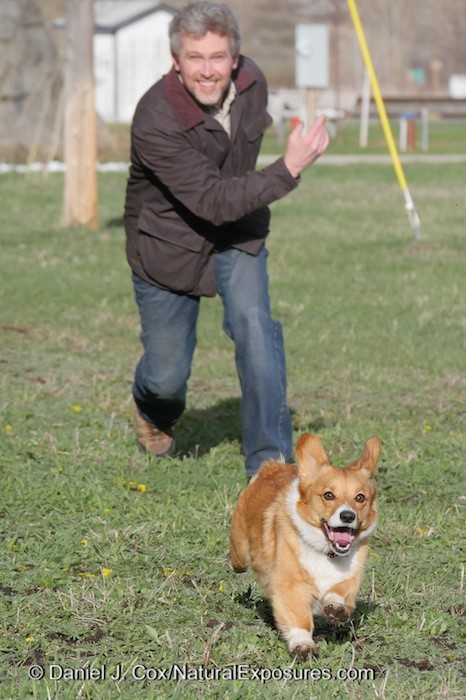
 Bozeman Camera’s owner Marshal Lewis just gets through his windup and Benny is out of the gate.
Anyway, virtually all the hype on the the new Lumix GH4 has been centered around the 4K video. I too am excited about 4K but I’ve been frustrated that so little has been talked about regarding the individual, still image, attributes of the GH4. Camera in hand, I borrowed a friend and his dog. Yes, it was time for the speeding pooch test. My friend Marshal Lewis from Bozeman Camera, his girlfriend Caroline and Benny the blazing Corgi agreed to stop by the studio to see what the GH4 could do in Predictive AF. Marshal pulled up, opened the door to his Toyota Forerunner and a streak of beige colored fur came bolting from the back. ” Hi Dan,” Marshal shouted above the barks, “I figured a test of a micro camera deserved a micro dog”. “Oh, yea, micro dog but mega energy,” I thought. “He’s perfect,” I shouted above the din.
After a little catching up and an introduction to Caroline we got down to business which Benny was happy to do. I sent Marshal down field about thirty yards and explained the process. “Just do your best to pitch the ball straight over my head. I want Benny running straight at me.” Benny took the mark and Marshal fired the ball. The miniature rocket with six inch legs came to life and zero to sixty in about 1.3 seconds. I did my best to keep the AF sensor on the miniature bundle of yapping fur. I stepped on the trigger of the diminutive camera and it started its job of capturing 7 frames per second, the viewfinder staying live, no images blocking my ability to keep the camera on my subject. “WOW” I said to myself. That was the first indication this camera is a different beast than the GH3’s I’ve been shooting.
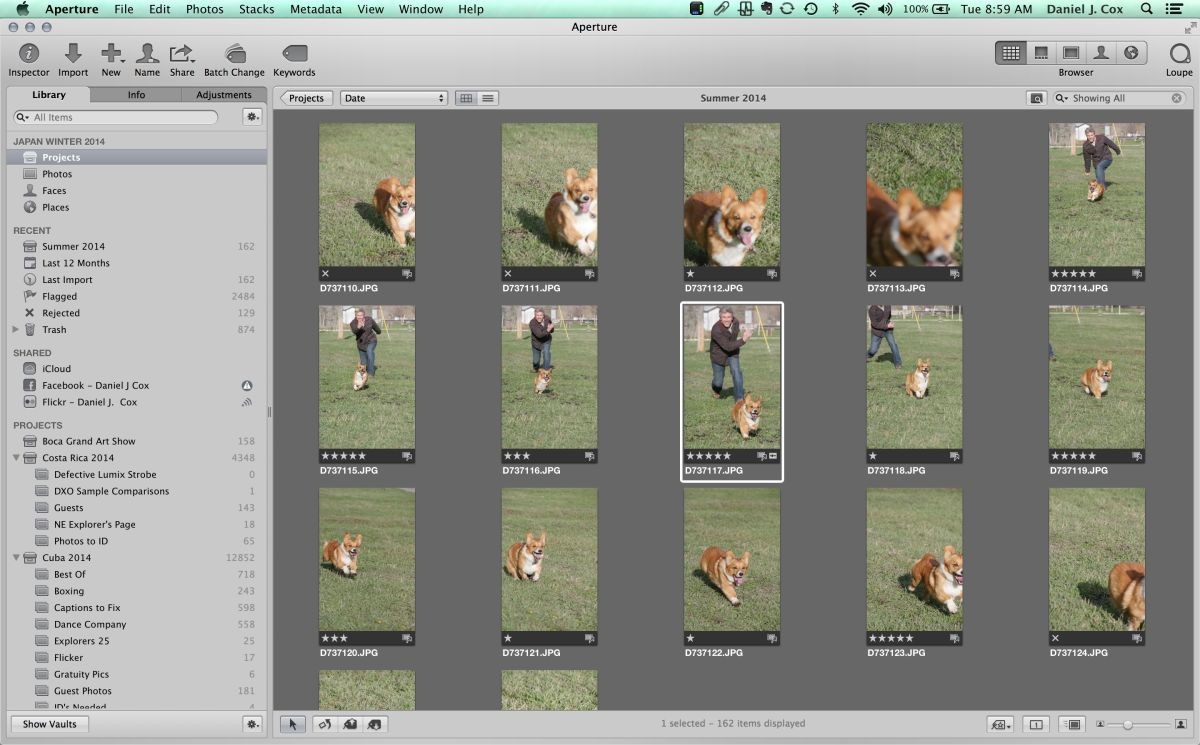
The ability to see Benny from start to finish was a big change from the GH3. Up to this point, action photography wasn’t really possible with any Micro Four Thirds camera I had ever tried. Although the GH3 has the ability to shoot at 6 frames per second, those frames would block up the viewfinder as they were being written to the card. Let me explain. Most everybody who’s ever shot a mirrorless camera has seen the default setting that immediately presents the photo on the rear LCD or in the viewfinder. It’s called Auto Review. That’s a nice feature when your snapping a picture now and again. But it’s a huge hinderance when shooting action. With the GH3, even though I would turn the Auto Review completely off, the system would still show an image for a split second. One image and you have no idea it’s even happening. At 6fps however, those multiple, micro second images turn into what looks like one complete captured photo, blocking your view of the subject as it runs or flies completely out of the viewfinder. You pull your camera down and the subject is long gone though you thought it was right in front of you. Serious action was not an option, until now. The GH4 seems to have solved this serious flaw in a mirrorless camera.
Next problem on the block to check for was the camera’s ability to predict where Benny was going to be when the camera fired and captured the image. That’s what’s known as Predictive Auto Focus. This is not an easy process and even the best cameras like a Nikon D4 has about an 80% success ratio in my Speeding Pooch Tests. We threw the ball for Benny nearly a dozen times and as he was running at the camera the GH4 looked like it was doing a reasonable job keeping him in focus. However, I wasn’t checking the rear LCD and I know from experience, what looks pretty good in the viewfinder, doesn’t’ necessarily tanslate into a sharp image on the computer. I was doing my best to temper my excitement.
Best Settings for Fast Moving Action
Before Benny started his evening exercise routine I made some changes to the GH4’s settings that put the camera on the right footing for shooting fast moving action. First I switched the Auto Preview to OFF in the menu system. Next I set the cameras AF Mode to 1-Area by way of the Q-Menu button on the right upper side of the back of the camera. Finally, I moved the AF switch to AFC, located just to the left of the Rear Command Dial. The GH4 does have a specific AF setting called AF Mode-Tracking in the Q-Menu which would seem to be the proper AF setting. However, just like the GH3, when I tried this setup the camera seems to be following the color of the moving object and the AF sensor moves constantly all over the viewfinder. I want the AF sensor to stay in the middle of the viewfinder and I don’t want the camera AF sensor following the subject. A moving AF sensor sucks up lots of computer processing power which is better used on the task at hand, driving the lens and predicting focus. it’s my job to keep the camera on the subject. It was these settings that we ran the tests with.
We finished shooting and all went our separate ways. I made a bee line straight to my Mac Book Pro loaded the card and Aperture began the process of importing the images to my hard drives. Up they came one by one. I let them all finish and then began the process of checking the sharpness at 100%. As usual it started out very good since the further away the subject is the easier it is for the camera to acquire proper focus. After checking all the images I was elated.
Out of 162 images these are the numbers produced by the new Lumix GH4. Click on the link below to see the page of images that show all photos captured including out of focus and no subject. I wanted to show them all.
Lumix GH4 & the Speeding Pooch Test.
0 Star= 30 Throw out due to missing dog completely or too close for lens to focus.
1 Star= 47 Out of focus, I would not keep this image
3 Star= 12 Somewhat in focus. Not acceptable for publication
5 Star= 72 Razor sharp!
These numbers are dramatically different than the tests I ran with the GH3 about one year and two weeks ago. You can see my Panasonic Lumix GH3 Predictve AF Tests here. It was so bad I didn’t even rate the good and the bad. They we’re pretty much just all bad. I can hardly believe Panasonic has accomplished these dramatic improvements in such as short period. I’m constantly left shaking my head at how quickly this company is catching and in many ways surpassing the biggest brands that have been producing cameras for decades. Panasonic’s been in still cameras for maybe 10 years. The technology Panasonic invented to help accomplish better Predictive AF is what they call DFD which stands for Depth From Defocus. To better explain this technology I’ve reached out to a great crew at Imaging Resource who does superbly detailed, technical reviews of the photo industries newest technologies. Below is a snippet from Imaging Resources first look at the Lumix GH4. Thank you to Dave Etchells and Imaging Resources for allowing me to share this with our readers here on the Natural Exposures blog.
Tech Insights: Panasonic’s DFD autofocus technology- by Imaging Resource
With the GH4, Panasonic has introduced an all-new autofocus algorithm that eliminates many of the drawbacks of contrast-detect autofocus, and delivers AF speeds approaching those of traditional SLRs. DFD stands for “Depth From Defocus,” and to understand what this is all about and why it’s such an impressive innovation, let’s first take a quick look at how camera AF systems work.
In traditional SLRs, the mirror system diverts a small portion of the incoming light to a separate autofocus sensor, typically located in the bottom of the mirror box. A prism there splits the light coming from opposite sides of the lens and directs it to paired groups of sensor pixels, forming each AF point. Depending on the focus of the lens, the light falling on the paired groups of pixels will either line up (focused) or be shifted one way or the other relative to each other (front-focused or back-focused). Phase-detect AF thus not only knows whether the subject is in focus or not, but if out of focus, it knows in what direction and how much out of focus the image is. This means the camera can command the lens to move directly to the correct focus setting, without having to “hunt” along the way.
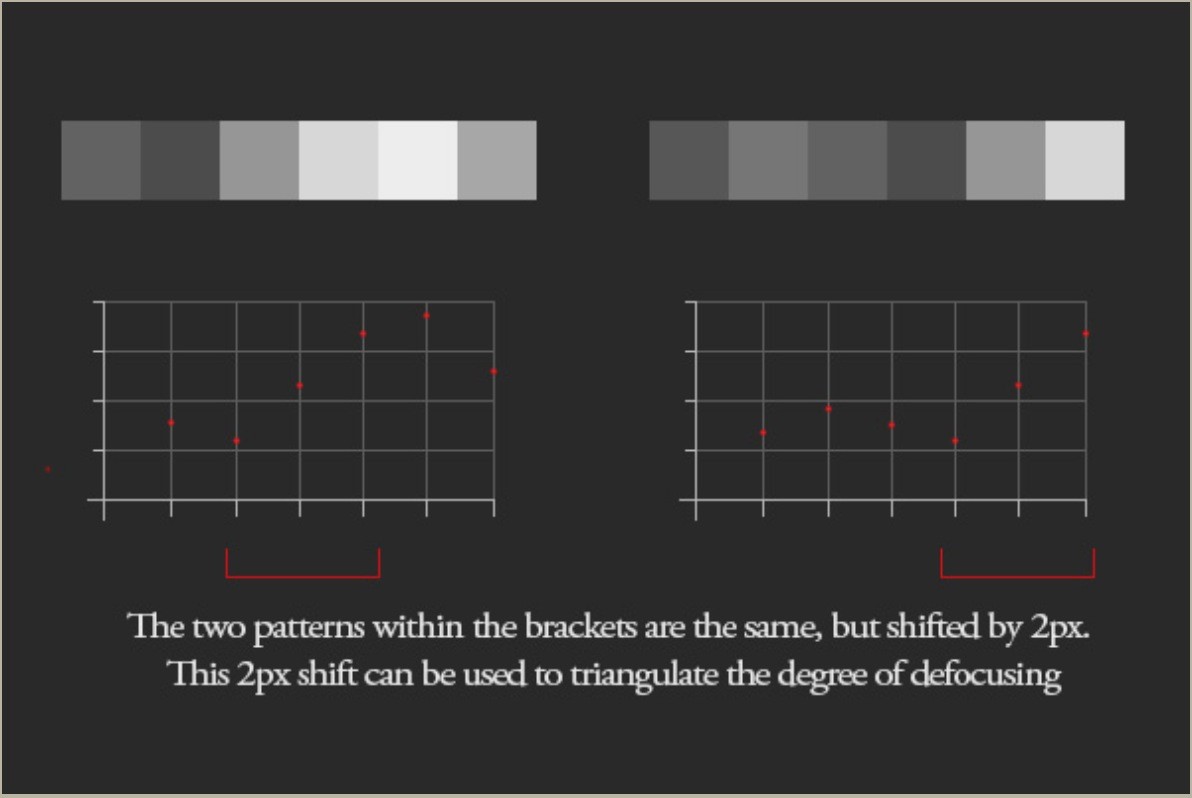
 This image and text explaining DFD was graciously loaned to us for this Blog by Imaging Resources. You can click on the following link to be taken to the Imaging Resource web site. The information above shows how the split images seen by the two halves of a conventional phase-detect AF point explicitly show the amount of defocus in and image. Image courtesy of and copyright 2013 by Rob Taylor. Rob has a great tutorial on How AF Works on tuts+ Photography.
So that’s about it for now. I must say that I would love to do another test just like above and use a larger dog, one that runs in a straight line. That’s hard to find, although I’ve had hunting dogs that are more consistent. That said, a small, eradicate spit fire like Benny is also a very worthwhile test since there aren’t many wild animals you can convince to run in a straight line either. Thanks to Benny, Caroline, and Marshal for giving me a hand with my first Speeding Pooch Test with the new Lumix GH4. Give Bozeman Camera a call for almost all your photographic needs other than Panasoinc right now. I’m still working on Marshal to bring the Lumix line to Bozeman. Until then I’m getting great service from Samy’s Camera in LA as well as Hunts Photo on the east coast. Maybe after Marshal sees this report he’ll take Panasonic more seriously. It took me a while to figure Panasonic out but I can tell you for certain, the GH4 is the real deal.