

Mylio May Just be the Next Big DAM Thing. A few months ago I introduced the readers of this blog to a new piece of software called Mylio by way of my friend Kevin Gilbert’s guest appearance on TheGrid. When I first heard of Mylio, my gut reaction was hmmm…that’s kind of a cool name, but I also thought it certainly needs to offer more than just a catchy title. Thankfully, after a bit more research, I’ve found it does offer more. All coolness aside, Mylio actually stands for something quite logical. It’s an acronym of sorts for a shortened version of My Life Organized. And for this converstion, My Life refers to, My Pictures. I like names that stand for something, especially when that something is a goal I’ve been perusing for literally decades–photographic organization.
[vimeo]https://vimeo.com/110821798[/vimeo]
With Mylio, photographic organization refers to collecting and storing every image you’ve ever shot or even pictures that others have shot of you, placing them all in one catalog, and keeping them in a safe place off site, also known as the cloud. The final icing on the cake is the fact you can see all those images, or as many as you choose, on each and every device you own, including your phone, tablet, PC, Android, on both Mac and Windows platforms. The key to the brilliance of this idea is Mylio’s ability to sync just THE PHOTOS YOU CHOOSE, unlike Apple’s new Photos program which requires a full-blown commitment of your entire library to the cloud. Mylio doesn’t. Keeping a backup of your photos off site is a great idea and the video below helps drive the point home.
[vimeo]https://vimeo.com/106542474[/vimeo]
As I said above, my search for photographic organization has spanned decades and I’m not exaggerating. I bought my first MS-DOS PC, an Epson Equity, clear back in 1981. I desperately wanted to buy a Mac but I had a good friend who was involved with computers that convinced me to buy the software first and then buy the computer it would run on. In those days THE software was a program known as Phototrack. Phototrack was simply amazing in its ability to create a database of images based on captions, keywords, and bar codes that all attached via small labels to the cardboard mounts of my nearly 500,000 transparency/slide collection. My father told me early on that if I was crazy enough to try and make a go of photography I had to treat it like a business. To that end I went out and bought an MS-DOS based Epson Equity personal PC and started organizing my photographic life.
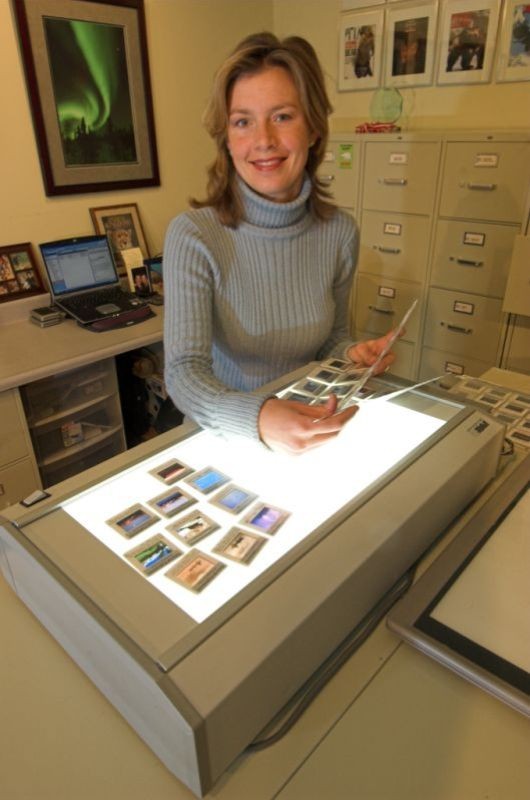
 Tanya sorting through a small collection of my 500,000+ slides/transparencies that were filed in plastic sleeves, 20 to a page and hung in five drawer filing cabinets.
It was very rewarding to submit to publishers a well organized package of images that included a contract listing all photos by way of their individual ID, info regarding how many pictures were contained in the package, each image’s lost or damaged value, as well as a caption for every single picture. All these details were printed out on computer paper in triplicate so I could keep one, the editor would keep one, and the last was returned to my office signed and dated. It was pretty intimidating for most editors to get such a well organized package from a 21-year-old businessman/photographer. Ok so I was a kid 🙂 Anyway, I was all business and being so well organized gave the perception of value which helped drive interest in the photography in each package.
Fast forward from 1981 to 2015, and along comes Mylio. Mylio came onto my radar with the demise of my favorite Digital Asset Management program, Aperture. I had hoped that Apple was going to give us more professional plug-in options for the new Photos program that’s replacing Aperture and iPhoto; however, based on what’s being written and seen by beta testers, the ability to make Photos more powerful through plug-ins will most likely not happen for at least a couple of years and very likely never. So…I’m looking for something else, and Mylio may just be the answer.
This post is not a full-blown review. Actually, I’m writing this more out of excitement for what I think Mylio is and where it will most likely be headed.
Mylio’s Cost: It’s A Subscription Service
First let’s talk about the cost. It’s subscription based and there are many who just don’t like the idea of paying a monthly fee. Monthly payments make some folks crazy. However, you can gat a free account that will hold up to 1,000 photos. For any serious photographer, you would need to move up to Mylio Basic which is a reasonable $50.00 per year. That’s less than $5.00 per month! With the Basic plan you get to sync three different devices, upload up to 50,000 pictures, and you get 5GB of Mylio cloud storage.
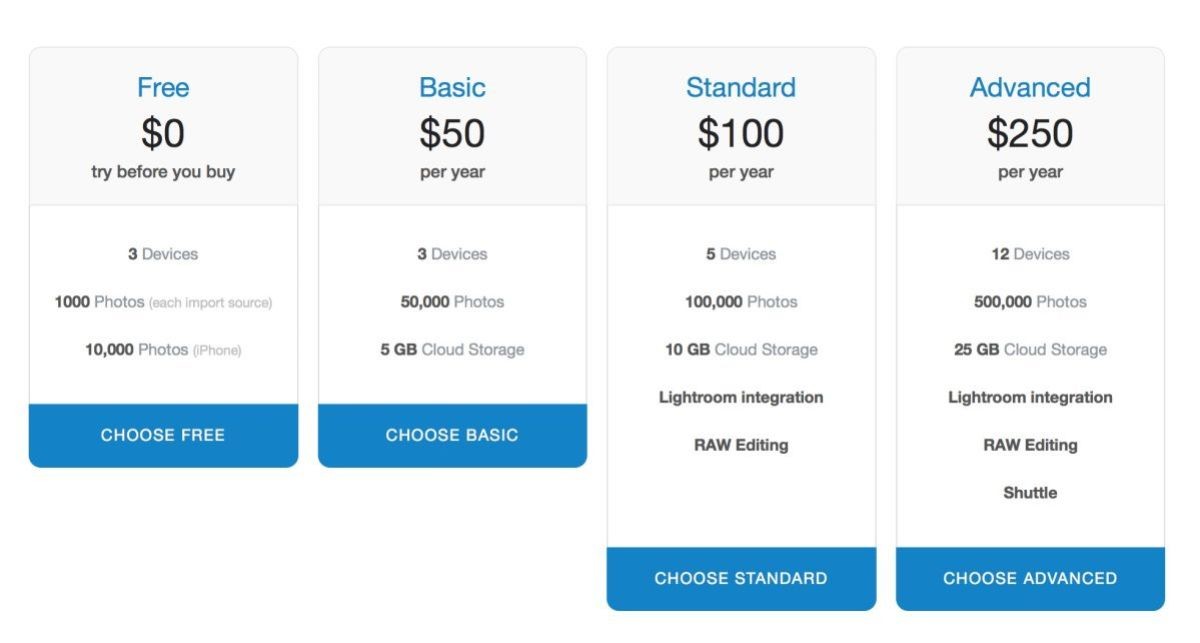
 Mylio pricing structure. Click on the image to be taken to the Mylio page describing costs.
The next plan is called Mylio Standard. The Standard plan is $100.00 per year, or $8.33 per month. You get an account that allows for 100,000 photos, 10GB of cloud storage, Adobe Lightroom integration, as well as non-destructive RAW editing of all your digital images. Mylio allows RAW editing on ANY device including iPhone and iPad.
Last and definitely the most expensive is Mylio Advanced. The Advanced plan will set you back $250.00 per year or just short of $21.00 per month. You get to sync up to 12 devices and upload up to 500,000 photos. It also includes 25GB of cloud storage, Adobe Lightroom integration, RAW editing, and Shuffle. By the way, I have no idea what Shuffle is.
So those are the costs and quite frankly, I don’t feel they are all that bad. I’m guessing they may even come down in the future since all things digital typically do. But if they don’t, the value is still pretty amazing. I’ve always thought subscription plans were great incentives for a good software company to continue innovating. When they don’t, you just drop your account and find something else.
What does Mylio do and how does it do it?
Mylio Saves Your Memories
Mylio is a home base for all your photos or the ones you really want to make sure to save, back up, and protect. You can have all your photos on a local hard drive located in your home or office. You can then tell Mylio which of those images you want a copy of in the Mylio cloud. The cloud images are the ones you’ll be able to edit and see from any device. Those that are not in the cloud won’t be seen by your other devices unless you’re in the area of your main database connected via WiFi. At least that’s how I understand it. If somebody from Mylio is reading this, please jump in and clarify that for us if you would in the comment section below.
[vimeo]https://vimeo.com/122489876[/vimeo]
Mylio Allows Instant Editing Capabilities
When you see editing changes made on your iPad pop up within seconds on your iPhone, desktop PC, or Mac, it’s hard to believe. You make a crop, change the white balance, change exposure, sharpen the photo, or anything else on the device in your hand and within seconds it shows the same changes on ALL of your other devices. It’s as close to magic as I’ve ever seen. Many of us who travel with small groups of like-minded photographers know how easy it is to get caught up in your tent or cabin working on your pictures. With Mylio you can bring your iPad with you, work at your leisure, and leave the tent or cabin behind. Mylio has the potential to make our trips more social and get work done to your images to boot.
Mylio Works with X-Rite on Your iPad for Goodness Sakes!
This is an industry first as far as I know. A photography program that will automatically connect to the X-Rite iPad app and sync the color profile on your iPad. Keep in mind that a supported X-Rite measurement device is required for the calibration process. Supported devices are ColorMunki Smile™, ColorMunki Display™, i1Display Pro™, and i1Pro 2™, but color calibration is possible. This gives you the ability to tweak your photos from your iPad! When you return home or to your office, all the changes are already in your main desktop library, with the color calibrated changes you made while you were on the road. This is going to be a huge time saver. Video below shows the X-Rite app.
[vimeo]https://vimeo.com/123988894[/vimeo]
Mylio Has A Superb Leader And Is Driven
If you know the history of the lead developer and CEO of Mylio, you come to realize this is going to be the sleeper program nobody dreamed of. David Vaskevitch was one of the head Mucky Mucks of software design at Microsoft for many years. He left, as many MS employees have done, and decided to do something on his own. What’s important to this story is, David LOVES photography and he’s in charge of making sure ideas are implemented in the Mylio software. Like the color calibration option for iPad. That’s the kind of commitment we’re going to see over time I believe. I don’t see Mylio trying to compete with Lightroom as editing software, but I do see it competing on the DAM side with basic to moderate tools for adjusting your pictures. I believe Mylio is going to be the answer for making the DAM (Digital Asset Management, a.k.a., keeping track of your precious memories) simple and efficient and at the same time leaving the heavy lifting for digital editing to the likes of Photoshop, Pixelmator, or DXO for creative changes or tweaking. Bottom line is Mylio has a driven leader and that is always a huge bonus.
Mylio Has An Aperture Migration Tool Coming Soon
In my recent discussion with the folks over at Mylio, they have informed me that they’re nearly finished with building an Aperture migration tool. I’m being told it won’t just be keywords and captions but actual edits as well. I’ve been warned the edits won’t be perfect as far as colors and other details but they will be close. For me, I’m not that worried about edited images exporting from Aperture to Mylio. I’m mostly interested in the keywords and captions. I’m being assured that keywords and captions are going to import without a hitch. I do know there are others that are very interested in edits being exported, and for you folks it’s amazing to hear it has the ability to happen. Aperture to Lightroom migration tool doesn’t even mention edits coming over in any way. And that’s if you can get it to work. I’ve tried and never was able to get an Aperture library migrated to Lightroom.
Mylio Does XMP Side Car Files
One of the downsides when I moved from Lightroom to Aperture was the loss of the ability to generate XMP side car files in Aperture. Aperture had this ability when I exported a file but unlike Lightroom, I could not tell Aperture to make an XMP side car file for every image in the library without exporting. Why is this important? Because side car files are small little computer generated files that contain all the info of each one of your RAW files. It has the exact same number as your RAW file but with a different extension.
[vimeo]https://vimeo.com/123987465[/vimeo]
An example would be D123456.RW2 and right along side of it you would have D123456.xmp. This is the most effective way of keeping track of all the things you do to your RAW files without directly embedding those changes in the RAW file itself. This is the safest way you can work with RAW files and Lightroom did this with ease. Now Mylio has the same capabilities. Think of it as having a miniature backup of everything you’ve ever done to any particular picture. If you would ever lose your library, all you would have to do is reload your folders of images back into Mylio and all of your changes, edits, keywords, captions, etc. are loaded with the original RAW file. This is the ultimate in catalog/library backup.
Mylio Has Phenomenal Support
When I decided to give Mylio a go, I started loading my nearly 700,000 images and all did not go so well. I had some technical difficulties so I had to contact Mylio support. It began with Matt, and like a dog on a bone, he never gave up. I’m still having some issues with getting all Nikon D2H and D2Hs photos to be seen by Mylio, but Matt’s working on it even as I write this. Seems the D2H and D2Hs were such a bomb for Nikon, the Mylio team overlooked it. They weren’t the only ones. Even so, Matt’s been incredible and this was before he knew that I knew the boss. Now compare this with Adobe Lightroom where I’ve tried a dozen times to find a phone number to call for support, and nowhere am I able to find any number to call. I’m told that if I was on the Photoshop/Lightroom subscription plan I would be able to speak with somebody in India. Mylio doesn’t have a call center, but when I’ve emailed I’ve never waited longer than 30 minutes to get a response with somebody ready to sort things out.