

As I’ve been saying for quite some time now the mirrorless camera revolution is a freight train that will be impossible to stop. A new survey out of Japan, the leading country of all great new ideas in photographic tools, shows that mirrorless cameras are now selling better than all DSLR’s, and the Micro 4/3s cameras are leading the mirrorless charge.
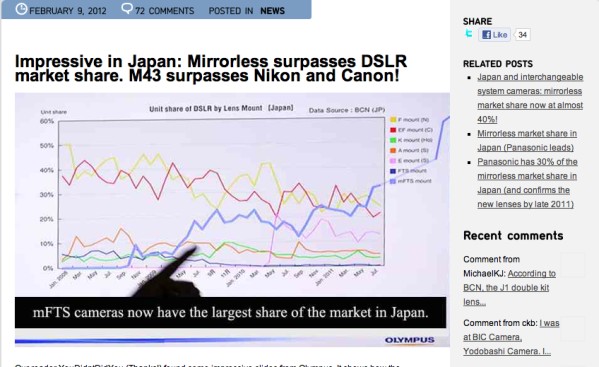
- Micro 4/3s Mirrorless cameras outselling DSLR’s in Japan
I just returned from our second year leading photo tours to Costa Rica and there was one other person beside myself that had a version of the Micro 4/3s system. Our group had several ongoing discussions regarding the changes we’re all beginning to see regarding more and more people turning to smaller and smaller cameras. Through those discussions I came up with a theory I would like to share with you.

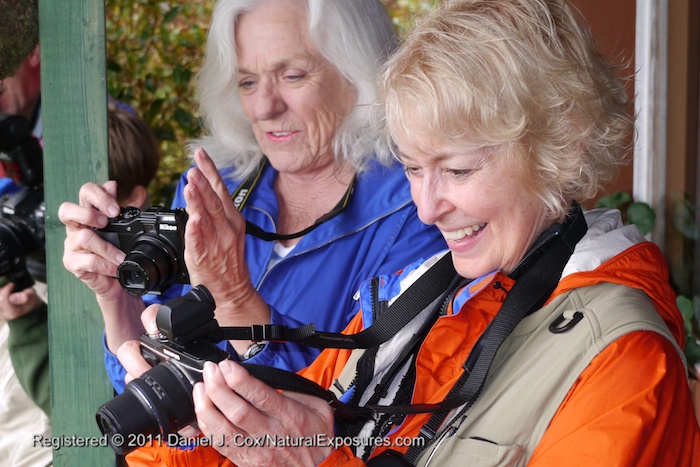
- Charlotte with her Olympus EPL-3 and Rosalis with her Nikon Coolpix 7100 having fun with their downsized systems. Here they are all smiles, but when the monkeys started swinging through the trees their smiles faded fast.
As many of you know, I’ve earned my living as a natural history photographer for many, many years. When I was 21 years old I bought my first Nikon 300mm F/2.8 lens. It was a beast, but based on the exquisite detail it produced in the transparency film I was shooting, I felt as an aspiring professional I needed to have that lens to make a living. It was somewhere around six pounds but the weight was worth it due to the sharper glass, the lower light situations I could shoot in and the fact that it was easier to MANUALLY focus due to a brighter image the large, front element allowed through the viewfinder. All of these benefits were worth the tremendous weight of the lens alone, but to make it work I had to add a Nikon F2AS body with motor drive. Combine it all and you had very close to a ten pound package sitting atop a tripod and a head that was an additional ten pounds. With all that weight it was essential to wrap the tripod legs in foam padding to keep from developing groves in my shoulders when I hiked for miles searching for pictures.
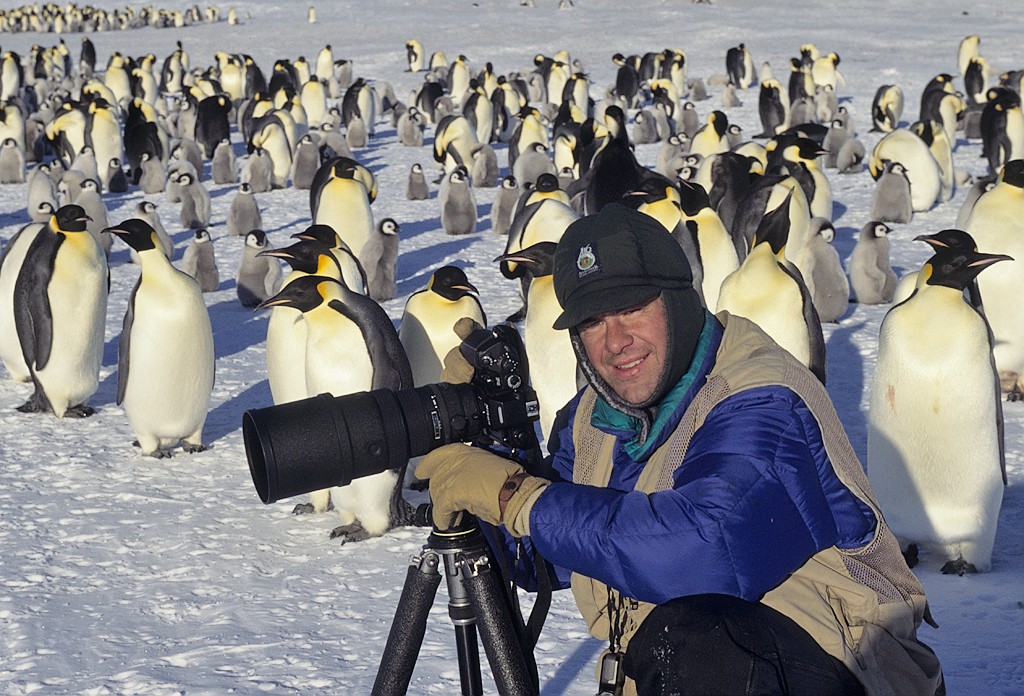
 That's me with my second or third version of the the Nikkor 300mm F/2.8 with Emperor penguins in Antarctica.
As my career progressed I eventually bought the ultimate king of optical beasts, a Nikkor 600mm F/4. Talk about additional weight. On my second trip to Kenya in 1992, I had a LowePro Super Trekker that contained a 600mm F/4, 300mm F2.8, 80-200mm F/2.8 and several smaller zooms. Add to that three camera bodies and the whole pack weighed nearly 65 pounds! I remember carrying that through the airports as carry on luggage along with a small duffel with 600 rolls of 35mm film that weighed an additional 40 pounds. After that trip I vowed to never carry that much weight again if at all possible. 2003 came along and Nikon released their 200-400mm AFS zoom. The minute I could buy one I did and when that happened, I sold both my 600mm F/4 and 300mm 2.8. It reduced the size and weight of my camera pack by about 40% and I was on my way to downsizing.
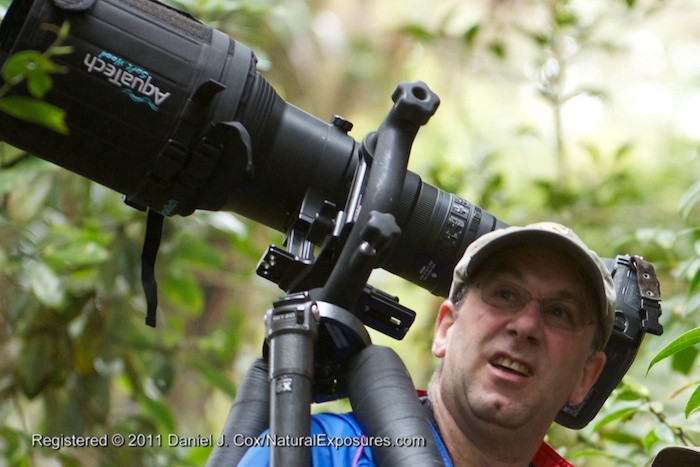
 Steve is feeling the pain on our recent trip to Costa Rica but he swears he was still having fun.
My reason for sharing all of this is to highlight what professional photographers are willing to put up with to make sure they have the best equipment possible to capture their images. Big heavy lenses, unfortunately, have always been essential in my quest to capture unique imagery of animals at the times they are most active, early morning and late evening. However, things are beginning to change and this is where my theory comes in as to why mirrorless, lighter lenses and cameras are starting to do so well.
My Theory Unveiled
Camera manufacturers have done a great job over the last ten years, convincing the masses to start shooting serious equipment. I’ve experienced this first hand by way of the folks we take to Alaska, Kenya, Costa Rica, Galapagos and other wildlife destinations around the world. Many people who travel with us actually have more equipment than I do including 300mm F/2.8’s, 600mm F/4’s, 500mm F/4’s and big zooms such as the Nikon’s 200-400. These casual shooters, that are photographing just for fun, have the desire to produce professional quality. They’ve done their homework and know that a 600 F/4 is the ultimate bird lens that serious pro shooters use to capture spectacular imagery. So homework done, many go out and buy the same lens I lugged around for mamy years to help me make my living. However, there is one big difference that isn’t taken into consideration when they fork over the nearly $10,000 to get that lens. That difference is they’re doing their photography for fun and I was doing mine for a paycheck.
Above is the new Olympus OM-D EM-5 Which may be a turning point in the field of Micro 4/3s world as far as speedy AF and frame rates are concerned.
As a professional I had to carry that lens. It was just part of the job. It was NEVER fun but it helped me get the images that made me a living. I was willing to accept the pain to make sure my family and I could eat. But isn’t that what all of us do when we’re trying to build a career? Almost everybody that is driven is willing to do things that aren’t always fun. You do things you wouldn’t necessarily do in other circumstances. So now that there are so many people shooting images for FUN, they are coming to realize, carrying all that damn weight doesn’t fit the pleasure description they thought they were signing up for. With sore shoulders and aching backs driving their research, I’m starting to see lots of people trying to figure out how to get great images with smaller, lighter equipment. And it’s that desire that’s forcing the likes of Panasonic and Olympus to offer alternatives that fit that bill.
Unfortunately, no mirrorless camera options have caught the likes of Nikon or Canon when it comes to fast moving subjects. The smaller mirrorless cameras work fine for landscapes, event shooting and general family photos, but when it comes to photographing a running cheetah there is still no comparison between traditional DSLR’s and the new mirrorless cameras. That will change however and I’m predicting sooner rather than later. When it does I hope Nikon is solidly in the game. They should be since they have a mirrorless camera themselves that has amazing technology that would benefit shooters of all shapes and sizes. I would love to see a D5 with the guts, brains and weight of a Nikon V1 and the sensor technology of the new Nikon D4. Drop me a line here on the blog if you have any thoughts you want to share.