

Cleaning a dusty sensor is quite easy. During our time here in Kenya we’ve traveled on some very dusty roads, and along the way I’ve been changing lenses now and again. In general, I try not to change lenses while in the field, especially in a place as dusty as Samburu National Reserve, but sometimes it just has to be done.
I’ve not noticed anything in particular on my sensors but I hadn’t looked really close. So before we start our second ten days in the field I decided to check my two GH4’s and found that they both needed cleaning. That being the case I thought I would share with you how I go about cleaning my cameras sensors.

 This is the sensor of one of my GH4’s before I did any cleanup.
The first step is check to if my sensors are dirty. I do that by taking a photo of a completely blank wall at the lowest aperture I can get. In this case it was F/22 with the Lumix 12-35mm F/2.8 lens. While in my hotel room I simply pointed the camera and lens, lens set to infinity, at my room wall. I didn’t worry about blurring the image with a slow shutter speed; in fact I actually prefer a slow shutter speed, since I move the camera around, so nothing small, like a spec on the wall, is registered in the photo. In this case the camera exposed the frame for about a 1/2 second at F/22, and as I shot the picture I actually moved the camera in a small circle.
This technique will show you the smallest dust specs on the sensor of the camera. After the exposure, I enlarged the frame on the back of the LCD and found there to be several small dust particles as well as what looked like four larger smudges in the shapes of small circles. The more detailed specs came off very easily with my small butterfly paintbrush, however, the larger smudge-like circles wouldn’t budge with the brush. I remembered I had seen this one other time and found that what was actually showing on the sensor were dust specs on the rear lens element. I removed the lens and cleaned the glass on the back, shot another test, and found that all specs and smudges had disappeared.
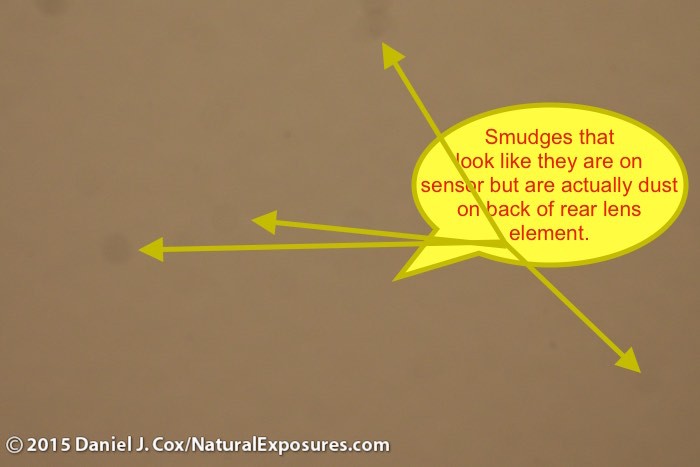
 A frame that shows the dust smudges coming from the rear element of the lens.
In the past I’ve spent a countless amount of time trying to remove these smudges. Once I realized they were out of focus dust spots on the rear glass element, it was easy to get the entire sensor as clean as new.
That’s all there is to it. I no longer even carry canned air. All my cleaning is done with a sensor cleaning brush which is ridiculously priced. If I had to do it again I would most likely just buy a simple, high quality, nylon bristled water color brush. I’m not convinced the digital sensor brush mentioned above is anything special, but it’s the one I currently use. Along with this brush I also use the LensPen which is for cleaning things that don’t brush off so easily. The LensPen allows you to polish the surface with no damage and I prefer the triangle shaped design.

 A final image of my newly cleaned sensor that took no more than maybe five minutes.
It’s all quite simple. I will say that the Lumix sensor is much easier to clean than my Nikon’s. Why, I have no idea. One possibility is there seems to be a broader border where you can use the tool completely outside the sensor box without hitting a wall. That alone makes it easier. Additionally, Panasonic seems to have some sort of protective cover that really cleans off easily. Maybe this is all in my head, but all I know is I don’t have to clean my Lumix sensors as often and when I do, they clean very easily.
Let me know if any of you have any other tips. Post them here on the Blog and happy shooting.