

Hi Dan,
I currently shoot with a Nikon D700. I’m contemplating upgrading my camera body. I have an investment in F/2.8 lenses. Your article on the four thirds cameras has me thinking maybe I should go mirrorless. I typically shoot low light landscape and macro. I’ve notice several pros have switched from their heavy Nikon systems for high quality mirrorless. Would I give up anything by making the switch?Thanks for your time,
Kathy Cavallaro
Kathy,
For the most part, there are few limitations to the Lumix Micro Four Thirds system I shoot compared to my old but trusty Nikon D700. The D700 was one of the first really great Nikons for low light capture. I have’t done any side by side comparisons, but I will tell you that low light is one area the MFT cameras don’t do as well in. The smaller the sensor, the more noise that comes in low light and higher ISO’s. I will often shoot my Lumix GH4 at 1600 ISO. I’m not excited about going higher than that but will if needed. When shooting at higher ISO settings, I typically run the original RAW files through my favorite noise reduction software DXO Optics Pro 11. Adobe’s Lightroom has a fairly decent noise removal tool but I really like the look of the images coming to of DXO Optics much better.
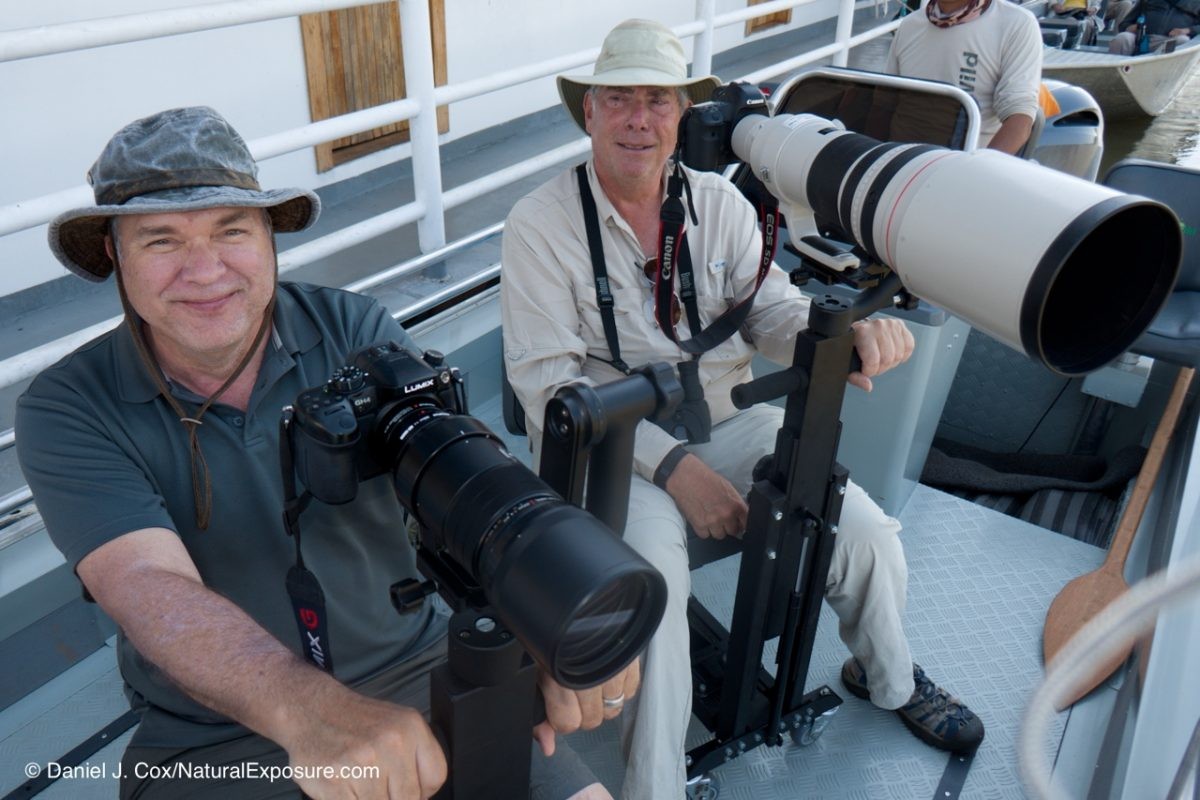
 Freddy is just way too confident with his baby Lumix system, and Peter’s about ready to let him have a lens full. Oh, by the way, Freddy is shooting 840mm and Peter has 600mm. Pantanal, Brazil
I would be interested in knowing which 2.8 lenses you’re referring to. If they’re big glass lenses like a Nikkor 300mm F/2.8 I can tell you the money you get from selling a lens like this will easily pay for an entire Lumix system. I’ve sold almost all my big Nikkor lenses, my 500 F/4, 2 200-400mm, and 2 80-400mm . With that money I’ve been able to purchase all my Lumix equipment, I have almost every lens they make, and when all was said and done, I put

 Tree frog from Costa Rica shot with Lumix GH4 and Leica 45mm F/2.8 macro lens. One flash off camera fired by Lumix wireless remote system.
thousands of dollars into my retirement account, money that was leftover from the sale of the very expensive Nikon lenses. Keep in mind, not all mirrorless cameras are created equal. Sony, for example, is making a superb mirrorless camera but it’s full frame. That’s great for low light but the telephotos are actually larger than the big Nikon and Canon lenses of the same range. Even more disappointing is they cost more than the Nikon and Canons of the same range.

 The new Leica 100-400mm is going to revolutionize bird photography like nothing we’ve ever seen due to the tremendous reach of 800mm and the ability to hold it by hand. Bare-faced Curassow, male and female in the Pantanal, Brazil
That’s about it for a comparison. You’ll be missing super low light capabilities, though not a lot less than the Nikon D700. It was a great cameras in its day but there are many models that do much better in low light now. The GH4 is not quite as good as a D700 but it’s not too far off for low light capabilities. What you will gain is a pocket full of cash, a much smaller system that is a breeze to travel with, and some of the finest optics being built today in the Leica lenses that are made for the Lumix bodies. The lenses that are made for the Lumix cameras you have to multiply by 2 so the Lumix/Leica 100-400mm becomes a 200-800mm, but in the size of a 100-400mm. That’s the reason the image above shows one lens, the Olympus 300mm F/4 being so much smaller than it’s Canon
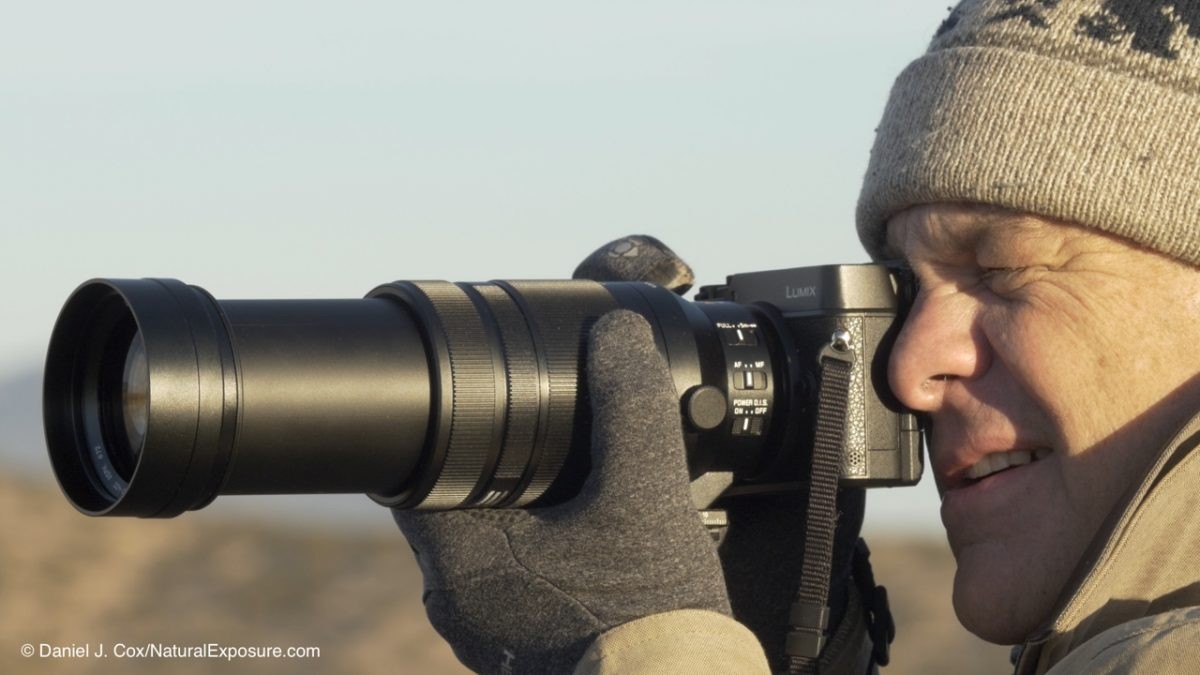
 Dan shooting the new Leica 100-400mm on birds, handheld at 800mm.
counterpart at 600mm F/4. Additionally, if you can’t find a lens that Lumix makes such as the 300mm F/4, you can always check out the lenses from Olympus. Two of my favorite are the 300mm F/4 and the 40-150mm F/2.8. In case you’re unaware, Olympus and Lumix share the same lenses mount. All Lumix lenses fit on the Olympus MFT bodies and all Olympus lenses fit on the Lumix bodies. I shoot the two Olympus lenses I mentioned above on my Lumix cameras. As good as Olympus lenses are, I definitely much prefer the Panasonic Lumix bodies. More ergonomic, easier to understand button placements etc., and a much, much easier to use Menu system. On top of that, the Lumix gear is virtually bomb proof. Every bit as durable as my Nikons.