

Some time ago, at least a year, maybe two, Canon announced they planned to offer their photographers a 200-400mm lens. The announcement came before the earthquake/tsunami disaster and I’m guessing that the natural event put things on hold. Well last night I ran across a website that showed a huge selection of Canon 200-400mm lenses stacked on a shelf and ready to be loaned out to Canon shooters at the Olympics.
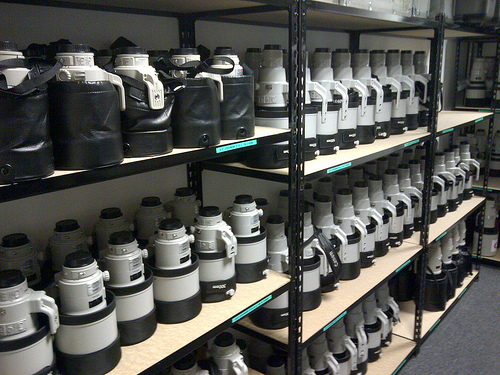
 Racks and racks of Canon lenses at the Olympics. Looks like the group in the lower right side of the frame, second row up are probably 200-400mm zooms.
Nikon made this zoom range famous back in the 80s and 90s with the help of Art Wolfe. Art swore by this lens. I can only imagine how excited he must be for the new AF Canon version. I too was a fan of the original manual focus Nikkor 200-400mm and bought one used in the late 80s for $1500.00. Nikon quit making this lens shortly after I bought it. Due to the 200-400’s popularity, much of it based on Art singing its praises and its eventual scarcity, I sold mine five years later for $6500.00. Yep, that’s right. I actually made money on it and all because of Art. I got rid of it knowing that most likely an AF version would be forthcoming. Nikon eventually came through and the rest is history. For years our Canon guests have salivated over this lens as we stand side by side taking photos in the field. That’s soon coming to an end.

 In the field with the most-used lens I own, Nikon’s 200-400mm F/4 Zoom.
Some folks still think that shooting a zoom lens is a disadvantage compared to fixed focal lengths. I feel 180° opposite. Yes, it’s possible that a 400mm F/2.8 may be a minute bit sharper, but the advantage of not having to get up and move in, move out, move back, move forward, you get my point – that’s huge! Not only does a zoom give you the ability to stay put and concentrate on getting the shot, but it also gives you an almost infinite number of other lens choices between the typical fixed focal settings you would be forced to use without a zoom.
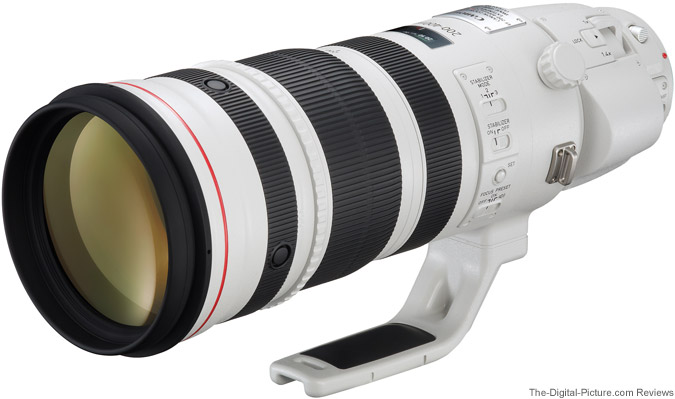
 Canon’s soon to be released 200-400 F/4 Super Zoom. Notice the bump on the right side at the rear of the lens. This is the space taken up by the built in teleconverter.
When I was just getting into photography I read all the articles that said, “you do not want a zoom. It just isn’t as sharp”. That was back in the late 80s when there might have been a fair amount of truth to that due to less quality optics compared to today. However, the first zoom I tried from Nikon was the original 80-200mm F/2.8 and by any standards was exceptionally sharp. At the time when people would suggest that I was at a disadvantage I didn’t try to convince them otherwise, since I was crawling my way up the ladder of success and desperately wanting to have every advantage I could get. I can now suggest that even if a zoom is a bit less sharp, I could gain so many more images due to being able to easily move in and out, and that I made more money capturing countless more images than if I were relegated to a fixed focal length. And even if they were a bit less sharp, it wasn’t enough to make a difference to an editor that in the old days was reviewing transparencies via a 4X loupe. He or she couldn’t see it. Only those looking through a microscope could.
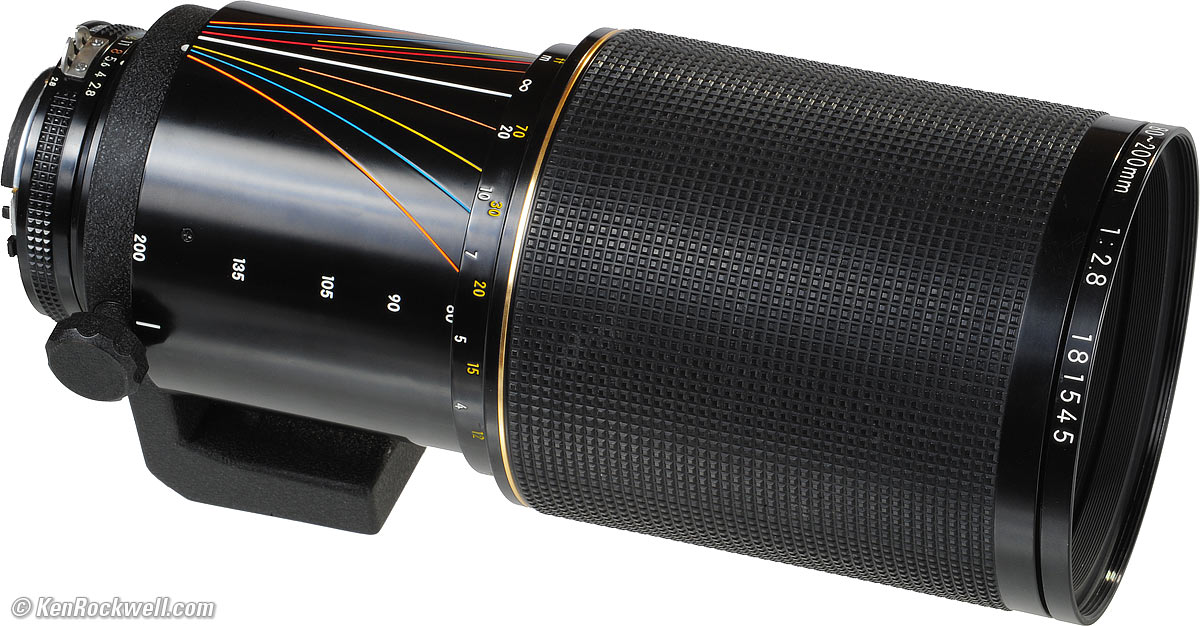
 An image of my favorite lens during my very earliest years in the photography business. Though you can’t see it in this image, this lens was huge, weighing 4.1 lbs. compared to todays 70-200mm F/2.8 at 3.4 lbs. Thanks to Ken Rockwell for having an image of this old lens that brought back many fond memories of my very first serious zoom.
The other huge advantage of a zoom is the ability to properly and more easily compose an image. This is something very few people talk about when it comes to discussing the advantages of zooms. Composition is a very subjective and personal thing. Some have a natural gift for it and most do not. However, a zoom gives you the ability to quickly recompose, rethink visually and then capture one to many different compositions of a particular scene. All very quickly and efficiently.
As you can understand, I’m a big fan of zoom lenses. Now our Canon brothers will have an option they’ve never had. That’s good for all of us shooting Nikons since competition inspires better products we all eventually benefit from. Nice job Canon.
One final bit of info I didn’t work in to the text above. A very unique feature of the Canon 200-400mm F/4 is its built-in 1.4 teleconverter that is activated by flipping a switch or something similar. Quite an interesting option that could have its advantages, since the teleconverter can be specifically built knowing it will only be used on that lens. This has the potential to allow Canon to build an even higher quality teleconverter than they would if it was attached separately. Teleconverters not being attached to a matched lens have always been an issue Canon and Nikon have struggled with. If you can match your teleconverter to your lens you should theoretically get sharper, higher quality results.